Attic ventilation in Gulf Coast homes is not just about moving hot air out — it's about managing moisture, balancing intake with exhaust, and avoiding the mistakes that make humidity problems worse. Standard cold-climate ventilation advice can actually cause condensation and mold in hot-humid climates like Mississippi, Alabama, and the Florida Panhandle.
After reading this page, you'll understand how ventilation works differently in hot-humid climates, which ventilation types are right for your home, and how to check whether your current system is adequate.
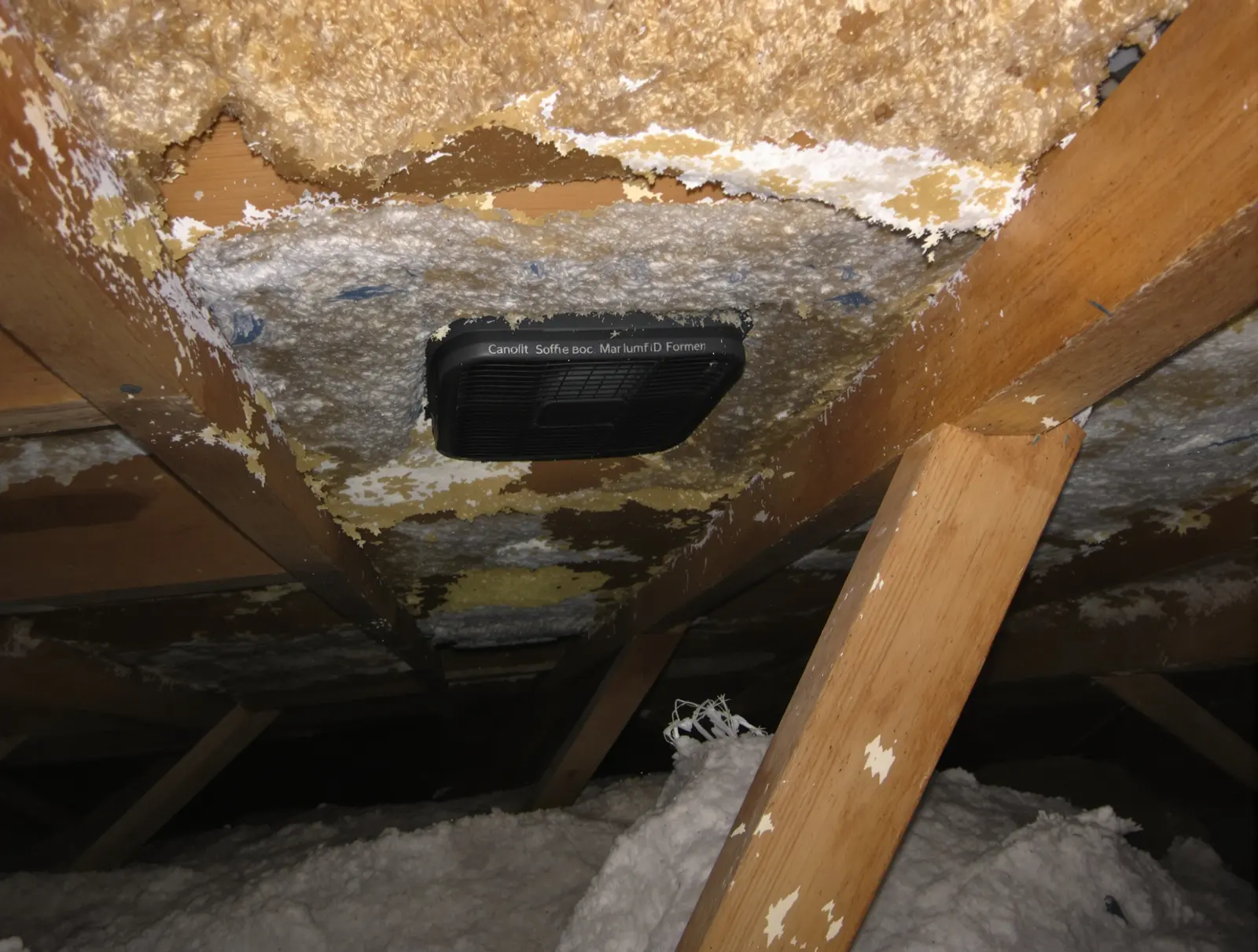
Why Attic Ventilation Matters Differently on the Gulf Coast
Most attic ventilation advice is written for cold climates. In northern states, the primary goal of ventilation is preventing ice dams and removing moisture that migrates upward from heated living spaces in winter. The standard recommendation — more ventilation is always better — works fine when outdoor air is cold and dry.
Gulf Coast homes face the opposite problem. From May through October, outdoor air along the Mississippi coast, Mobile Bay, and the Florida Panhandle carries 70-90% relative humidity. Pulling large volumes of that air through the attic introduces moisture rather than removing it. This is why homes in Biloxi, Pensacola, and Mobile develop attic mold that homes in Minnesota never see.
The temperature problem is real but secondary to the moisture risk. A poorly ventilated attic on the Gulf Coast can reach 150-160°F on a 95°F summer day. Proper ventilation drops that to 110-130°F. That 20-40°F reduction matters, especially if ductwork runs through the attic — but only if the ventilation system is designed for humidity, not just heat.
The goal in hot-humid climates is controlled, balanced airflow — not maximum airflow. You need enough ventilation to reduce extreme heat buildup without creating a highway for humid air to reach cool surfaces where it condenses.
Common misconception:
More attic ventilation is always better. You can't have too much.
Gulf Coast reality:
In Gulf Coast climates, excessive ventilation pulls moisture-laden 85°F, 90% humidity air across cool AC ductwork and the underside of the roof deck. This causes condensation, mold growth, and wood rot. Balanced ventilation sized to code minimums is better than oversized ventilation in hot-humid climates.
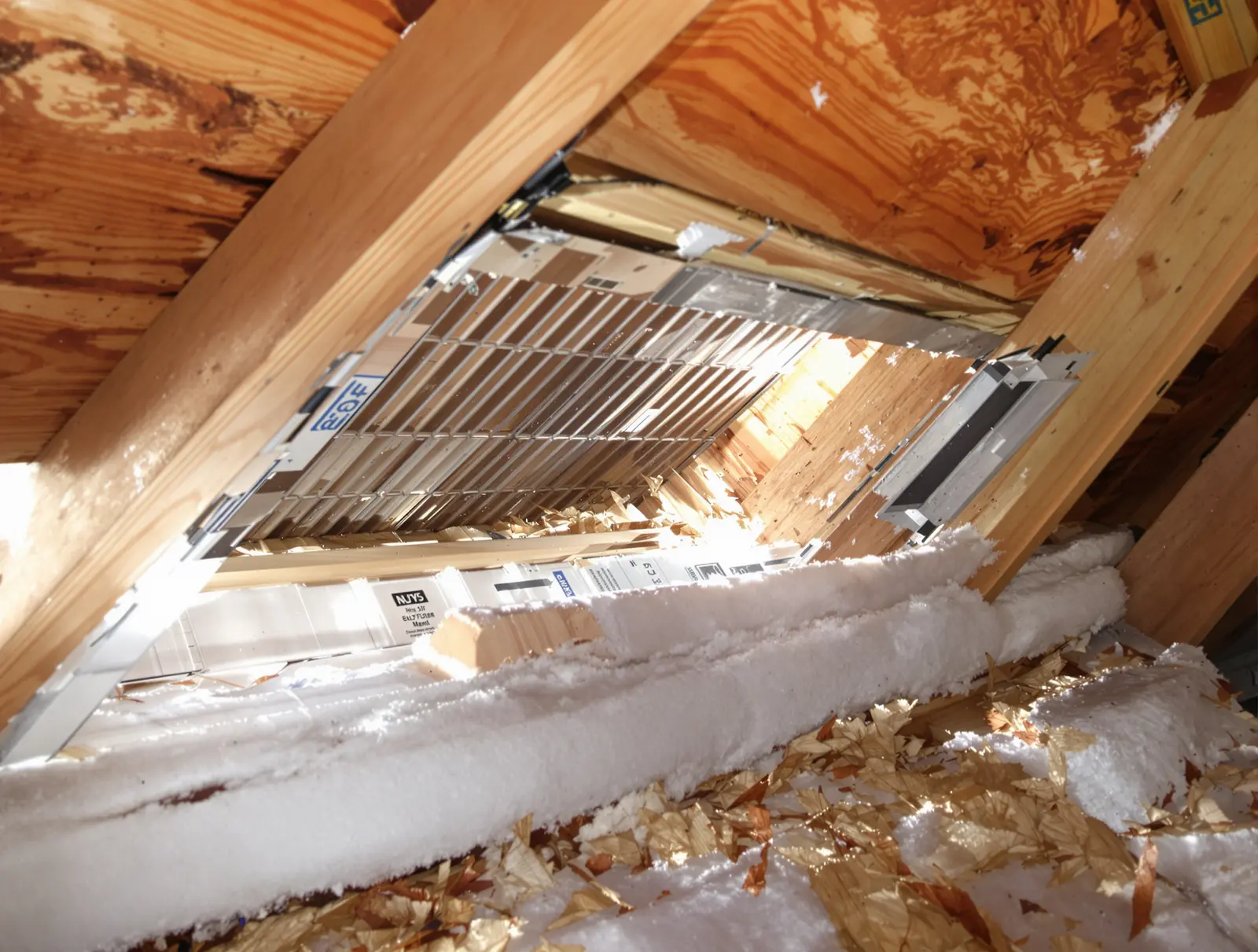
The Balance Concept: Intake vs. Exhaust
Every attic ventilation system has two halves: intake and exhaust. Intake vents bring air in at the lowest point of the attic — typically through soffit vents along the eaves. Exhaust vents let air out at the highest point — through ridge vents, gable vents, or roof-mounted vents near the peak.
Balance means having roughly equal amounts of intake and exhaust. The building code standard is a 50/50 split: half your net free area (NFA) at the soffits, half at the ridge or peak. When intake and exhaust are balanced, air flows naturally upward through the attic space — entering cool at the eaves, warming as it rises, and exiting hot at the ridge.
Most ventilation failures happen because intake is blocked. The number one ventilation problem in existing homes is insulation covering the soffit vents. When intake is restricted, the exhaust vents have nothing to pull from. The attic becomes stagnant. In some cases, exhaust vents actually reverse and pull conditioned air from the living space up through ceiling penetrations.
The 1:150 rule sets the baseline. Building codes require 1 square foot of NFA for every 150 square feet of attic floor space. With a balanced system and vapor barrier, that drops to 1:300. For a typical 1,500 square foot Gulf Coast home, that means 5-10 square feet of total vent area — split evenly between intake and exhaust.
Net free area (NFA) is not the same as vent opening size. A soffit vent's NFA accounts for the screening, louvers, and frame that block part of the opening. A standard 16x8 inch soffit vent has 128 square inches of gross area but only 64-77 square inches of NFA (typically 50-60% of gross). When calculating your ventilation, always use NFA values from the manufacturer — not the vent dimensions.
The 1:150 and 1:300 rules are minimum code requirements, not optimization targets. In Gulf Coast climates, exceeding these ratios modestly (by 10-20%) can help with peak summer heat. But exceeding them dramatically — particularly on the exhaust side — creates the negative pressure and moisture problems described above. More is not better after a point.
Think about it...
Your 1,800 sq ft attic has eight 16x8-inch soffit vents (NFA: 65 sq in each) and a continuous ridge vent rated at 18 NFA per linear foot across 40 feet of ridge. Is your system balanced?
Types of Attic Ventilation
Each ventilation type has strengths and weaknesses specific to Gulf Coast conditions. The best system depends on your roof geometry, existing setup, and whether you are reroofing or retrofitting. Here is how the main types compare.
Soffit Vents (Intake)
Soffit vents are the intake half of your system and the most commonly compromised component. They sit under the roof overhang at the eaves, bringing outside air into the lowest point of the attic. Individual soffit vents (rectangular openings every 4-6 feet) and continuous soffit strips (a perforated channel running the full eave length) are the two main types.
The problem: insulation blocks them in 60-70% of existing homes. Blown-in insulation migrates toward the eaves over time, covering soffit openings. Batt insulation installed without rafter baffles slumps against them. Either way, the intake is choked off, and the entire ventilation system fails. Learn how to check and fix blocked soffits.
Ridge Vents (Exhaust)
Ridge vents run along the peak of the roof and provide continuous exhaust along the highest point. They are the most effective passive exhaust type because heat naturally collects at the ridge. A properly installed ridge vent with external baffles provides 16-18 NFA per linear foot and works in any wind direction.
Ridge vents only work if soffit intake is open. Without intake air entering at the eaves, a ridge vent has no air column to draw from. Many homeowners install ridge vents during a reroof but never address the blocked soffits below — leaving them with a well-ventilated ridge and a stagnant attic. Read the full ridge vent guide.
Gable Vents
Gable vents are louvered openings in the triangular wall area at each end of the attic. They function as both intake and exhaust depending on wind direction. In calm conditions, they provide minimal airflow because they sit at the same height — there is no thermal difference to drive convection.
Gable vents work adequately in small, simple attics but fail in larger or complex roof structures. They ventilate the center of the attic poorly and create dead zones in hip-roof corners. They should not be combined with ridge vents — mixing these types short-circuits the airflow pattern.
Powered Attic Ventilators
Powered ventilators use an electric motor to force air out of the attic. They move 1,000-1,600 CFM and are typically thermostat-controlled to activate at 100-110°F. The DOE and multiple independent studies have found that powered fans can increase cooling costs by 20-40% in homes with ceiling air leaks, because they depressurize the attic and pull conditioned air upward.
Solar-powered versions eliminate the electricity cost but not the depressurization risk. They move 800-1,200 CFM during peak sun and less during cloud cover. Read the full solar attic fan assessment.
Interactive Attic Cross-Section
Click any component to learn about it, common problems, and related pages.
Ventilation Type Comparison
Interactive cards showing each vent configuration with diagram, Gulf Coast performance rating, and key notes. Click to expand details.
Think about it...
A homeowner has a hip roof with no ridge line long enough for a ridge vent. They currently have two gable vents. What ventilation strategy would you recommend for this roof geometry?
The Gulf Coast Ventilation Difference
Standard ventilation guides assume the attic is always warmer and drier than outdoor air. In cold climates, that is true for most of the year. The attic collects heat from below and moisture from the living space. Ventilation removes both. Simple.
On the Gulf Coast from May through October, outdoor air is often more humid than attic air. When the dew point outside is 75-78°F and your attic's ductwork and roof deck are cooled by the AC system to 65-70°F, bringing that humid air into the attic creates condensation on every cool surface. This is why ventilation design for the Gulf Coast requires a different mindset than ventilation design for Chicago.
The key differences for Gulf Coast ventilation design:
- Balance over volume. Match intake and exhaust NFA closely. Do not overventilate.
- Seal the ceiling plane. Every recessed light, plumbing penetration, and attic hatch that leaks conditioned air creates a cold surface for moisture to condense on. Air sealing the ceiling matters as much as vent sizing.
- Insulate ductwork thoroughly. Duct surfaces in a ventilated attic are the coldest thing in the space. If the duct insulation is torn, compressed, or missing, condensation drips onto the ceiling below. Learn about ductwork in the attic.
- Check for bathroom fans dumping into the attic. A bathroom exhaust fan venting into the attic rather than outdoors adds 50-100 pints of water per week to the attic space. This is the most common code violation in existing homes.
Common misconception:
Attic ventilation prevents mold. If you have mold, you need more ventilation.
Gulf Coast reality:
In Gulf Coast climates, more ventilation can cause mold by bringing in moisture-laden outdoor air. The solution for attic mold is usually reducing moisture sources — sealing ceiling penetrations, fixing bathroom fan venting, and insulating ductwork — rather than adding more vents.
Is Your Ventilation Adequate?
You can do a basic ventilation check yourself in about 20 minutes. You will need a flashlight ( ), a tape measure, and a dust mask. Go into the attic during the morning before it gets dangerously hot.
Check three things: intake, exhaust, and balance. First, look at the eaves where the roof meets the exterior walls. Can you see light through the soffit vents, or is insulation blocking them? Second, look at the ridge or peak. Is there a ridge vent, gable vent, or roof vent? Third, estimate whether the intake and exhaust areas are roughly equal — the ventilation adequacy checker can calculate this precisely from your vent measurements.
For a precise assessment, use the ventilation adequacy checker. It walks you through counting and measuring your vents, calculates your total NFA, checks code compliance, and evaluates intake-exhaust balance. Take the ventilation adequacy assessment.
Common signs of inadequate ventilation:
- Attic temperature exceeding 140°F when outdoor temperature is 95°F (use a to check)
- Visible moisture, dark staining, or mold on the underside of the roof deck
- Insulation that feels damp or appears discolored near the eaves
- Roof sheathing that shows signs of warping or delamination
- Ice dam history (rare on the Gulf Coast but possible in north Mississippi)
Ventilation Fixes During a Reroof
A reroof is the single best opportunity to fix attic ventilation. When the shingles and underlayment are removed, the contractor has direct access to add ridge vent, install rafter baffles at every bay, and verify that the entire ventilation path from soffit to ridge is clear. The incremental cost during a reroof is a fraction of what it costs as a standalone project.
Typical add-on costs during a reroof: Adding a ridge vent where none existed costs . Installing rafter baffles in every bay costs . These are among the highest-return investments you can make during a roof replacement.
If you are planning a reroof, tell your contractor you want a ventilation audit as part of the scope. Specifically ask: Will the new system have balanced intake and exhaust? Will rafter baffles be installed to protect soffit vents from insulation blockage? Will any existing gable vents be sealed if a ridge vent is being added? See the full reroof ventilation guide.
Think about it...
Why is a reroof the best time to fix ventilation, rather than doing it as a separate project?
What Ventilation Cannot Do
Ventilation is one piece of the attic thermal system, not the whole solution. Even perfectly balanced, code-compliant ventilation will not eliminate the comfort problems caused by other failures. If your ductwork is leaking conditioned air into a 130°F attic, ventilation will not fix that. If your ceiling insulation is R-13 instead of R-30, ventilation will not compensate for the missing insulation.
Ventilation reduces peak attic temperatures by 20-40°F, not 60-80°F. A dark-shingle roof on a 95°F Gulf Coast day heats the attic to 140-160°F. Good ventilation drops that to 110-130°F. That is meaningful — especially for duct efficiency and shingle longevity — but the attic is still far hotter than the living space. Read about the limits of ventilation.
The cause finder tool can help you identify whether ventilation is your primary problem or a secondary factor. It walks you through a diagnostic and ranks the most likely causes of your comfort issue. Take the 2-minute diagnostic.
Frequently Asked Questions
How much attic ventilation do I need?
The standard rule is 1 square foot of net free area (NFA) for every 150 square feet of attic floor space. With a balanced system (equal intake and exhaust) and a vapor barrier, that ratio drops to 1:300. For a 1,500 sq ft attic, that means 5-10 square feet of total vent opening, split evenly between intake and exhaust.
Can I have too much attic ventilation in a humid climate?
Yes. In Gulf Coast climates with 70-90% outdoor humidity from May through October, excessive ventilation pulls moisture-laden air into the attic. This can cause condensation on cooler surfaces like AC ductwork and the underside of the roof deck, leading to mold and wood rot. Balance matters more than volume.
Should I mix ridge vents and gable vents?
Generally no. When ridge vents and gable vents are combined, the gable vents can short-circuit the system. Wind hitting the gable vent pushes air across the top of the attic and out the ridge vent, leaving the lower attic and soffit area stagnant. Choose one exhaust type and pair it with soffit intake.
Do solar attic fans replace the need for passive ventilation?
No. Solar attic fans are supplemental at best. They move 800-1,200 CFM during peak sun, but they can create negative pressure that pulls conditioned air from the living space through ceiling penetrations. Passive ventilation with balanced intake and exhaust is more reliable and has no operating cost or failure mode.
What is the difference between NFA and vent size?
Net free area (NFA) is the actual open space air can pass through after accounting for screens, louvers, and frames. A 16x8 inch soffit vent has a gross area of 128 square inches, but the NFA is typically 50-60% of that — around 64-77 square inches. Always use NFA when calculating ventilation adequacy.
Will better attic ventilation lower my energy bill?
It depends on what else is going on. If your attic reaches 150°F+ because of blocked soffits and no exhaust, fixing ventilation can drop attic temperatures 20-40°F and reduce cooling load. But if your ducts are leaking or your insulation is inadequate, fixing ventilation alone will have minimal impact on energy bills.
What to do next
Quick recap
Attic ventilation in Gulf Coast climates requires balanced intake and exhaust, not maximum airflow. The most common failure is blocked soffits, and the best time to fix ventilation is during a reroof.
Your next step
Check your soffit vents for blockage — it's the single most common ventilation failure and it's free to diagnose.
Keep reading