Blocked soffit vents are the single most common ventilation failure in existing homes. When insulation covers the soffit openings at the eaves, your attic loses its intake air supply. The entire ventilation system stops working — even if you have a perfectly good ridge vent at the top. Fixing blocked soffits with rafter baffles ($1-3 per bay) is one of the cheapest, highest-impact improvements you can make.
After this, you'll be able to identify whether your soffit vents are blocked and understand how to fix them.
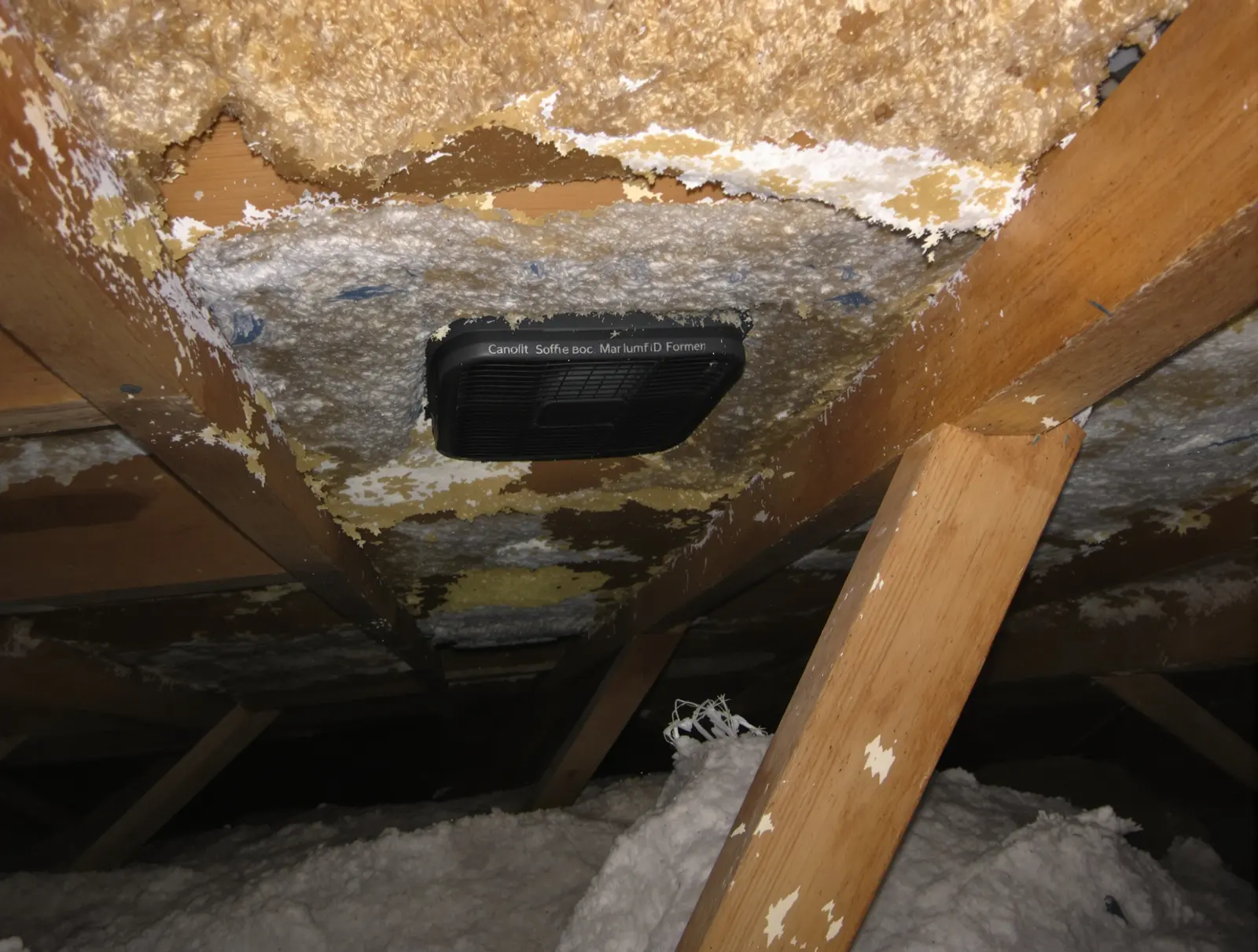
Why Blocked Soffits Are the #1 Ventilation Problem
Soffit vents are the intake half of your attic ventilation system. They sit under the roof overhang at the eaves and bring outside air into the lowest point of the attic. Without intake air, exhaust vents at the ridge have nothing to pull — the attic becomes a sealed box that traps heat and moisture.
An estimated 60-70% of existing homes have partially or fully blocked soffit vents. The blockage happens gradually. Blown-in insulation settles and migrates toward the eaves over time. Batt insulation installed without rafter baffles slumps against the soffit openings. Some homes had their soffits painted over during exterior work, or covered when new vinyl siding was installed.
The result is measurable. An attic with blocked soffits and a working ridge vent can be 20-30°F hotter than the same attic with clear soffits. In Gulf Coast summers, that means the difference between a 130°F attic and a 155°F attic. If your ductwork runs through that space, those 25 extra degrees translate directly into higher cooling costs and reduced comfort.
Blocked soffits also create a hidden moisture problem on the Gulf Coast. Without intake ventilation, humid air that enters through any crack or gap has no exit path. It stagnates, and when nighttime temperatures drop, that moisture condenses on the coolest surfaces — typically the AC ductwork and sometimes the underside of the roof deck. Over months, this leads to mold growth and wood deterioration. Learn more about attic moisture problems.
Common misconception:
Blown-in insulation in the attic can't block soffit vents — the insulation is on the floor and the vents are in the wall.
Gulf Coast reality:
Soffit vents open into the eave area where the roof meets the exterior wall. Blown-in insulation settles and shifts over time, piling up against this junction. From inside the attic, you'll see insulation pushed right up against (and over) the soffit openings at the eaves. This is the most common blockage pattern in homes with blown cellulose or fiberglass.
What You Need for the Inspection
This inspection requires basic equipment you may already own. The total cost for supplies is under $25 if you need to buy everything.
- Flashlight or headlamp ( ) — A headlamp is strongly recommended so you can use both hands
- Dust mask or N95 respirator ( ) — Non-negotiable when working near insulation
- Knee pads ( ) — You will be kneeling on narrow joists
- Long-sleeve shirt and pants — Insulation fibers cause skin irritation
- Rafter baffles ( ) — Buy enough for every rafter bay if you plan to fix the problem the same day
- Staple gun ( ) — For attaching baffles to the rafters
Step-by-Step Soffit Vent Inspection
Step 1: Choose a Safe Time
Enter the attic in the morning before 10 AM during summer months. Gulf Coast attics reach 130-160°F by midafternoon. Working in an attic above 110°F is dangerous — heat exhaustion can set in within 15-20 minutes. If it is already hot when you open the attic hatch, postpone to a cooler day or early morning.
Step 2: Look for Light at the Eaves
Position yourself near the center of the attic and look toward the eaves on both sides. With proper soffit ventilation, you should see strips or spots of daylight where the soffit vents allow outside light in. If you see a solid wall of insulation with no light anywhere along the eave line, your soffits are blocked.
Expected result: You should see daylight at regular intervals (every 4-6 feet for individual vents) or a continuous glow (for continuous soffit strips) along both eaves.
Step 3: Move to the Eaves and Inspect Up Close
Carefully walk or crawl along the joists toward one eave. Stay on the joists — stepping between them means stepping through the ceiling drywall. As you approach the eave, check whether insulation has migrated over the soffit openings. Look for insulation touching the underside of the roof sheathing at the junction where the roof meets the exterior wall.
Expected result: You should see a clear gap between the top of the insulation and the underside of the roof sheathing, with open soffit vents visible below. If insulation fills this space completely, the soffits are blocked.
Step 4: Check Multiple Bays
Do not assume the entire eave is clear because one section looks good. Check at least 4-6 rafter bays on each side of the attic. Insulation blockage is often uneven — some bays clear, others packed solid. Pay special attention to corners and areas near bathroom exhaust fans where insulation is often disturbed.
Checkpoint: At this point you should know:
- Whether you can see daylight through your soffit vents from inside the attic
- Whether insulation has migrated over the vent openings
- How many bays are blocked vs. clear
Think about it...
You checked 8 rafter bays on the south side of your attic. Five have insulation pushed up against the roof sheathing with no visible light. Three have a small gap but insulation is within 1 inch of the soffit opening. How would you describe your soffit ventilation status?
Check Yours: Soffit Vent Assessment
Answer these three questions based on your attic inspection. Then hit "Check" for an instant assessment.
How to Fix Blocked Soffits with Rafter Baffles
Step 5: Measure Your Rafter Spacing
Measure the distance between two adjacent rafters at the eave. Standard rafter spacing is 16 inches on center or 24 inches on center. Some older Gulf Coast homes use non-standard spacing. Rafter baffles are sold in both sizes — buy the size that matches your rafters. If your spacing falls between standard sizes, use the wider baffle and trim to fit.
Step 6: Clear Insulation from Each Bay
Pull insulation back from the soffit vent opening in each rafter bay by hand. You want to create a clear channel at least 2 inches deep between the top of the insulation and the underside of the roof sheathing. Pile the removed insulation temporarily behind the cleared area. You will push it back after the baffle is installed.
Wear your dust mask and long sleeves during this step. Fiberglass batts release fibers when disturbed. Blown cellulose creates dust. Neither is dangerous in short exposures with a mask, but both cause skin and respiratory irritation without protection.
Step 7: Install the Rafter Baffle
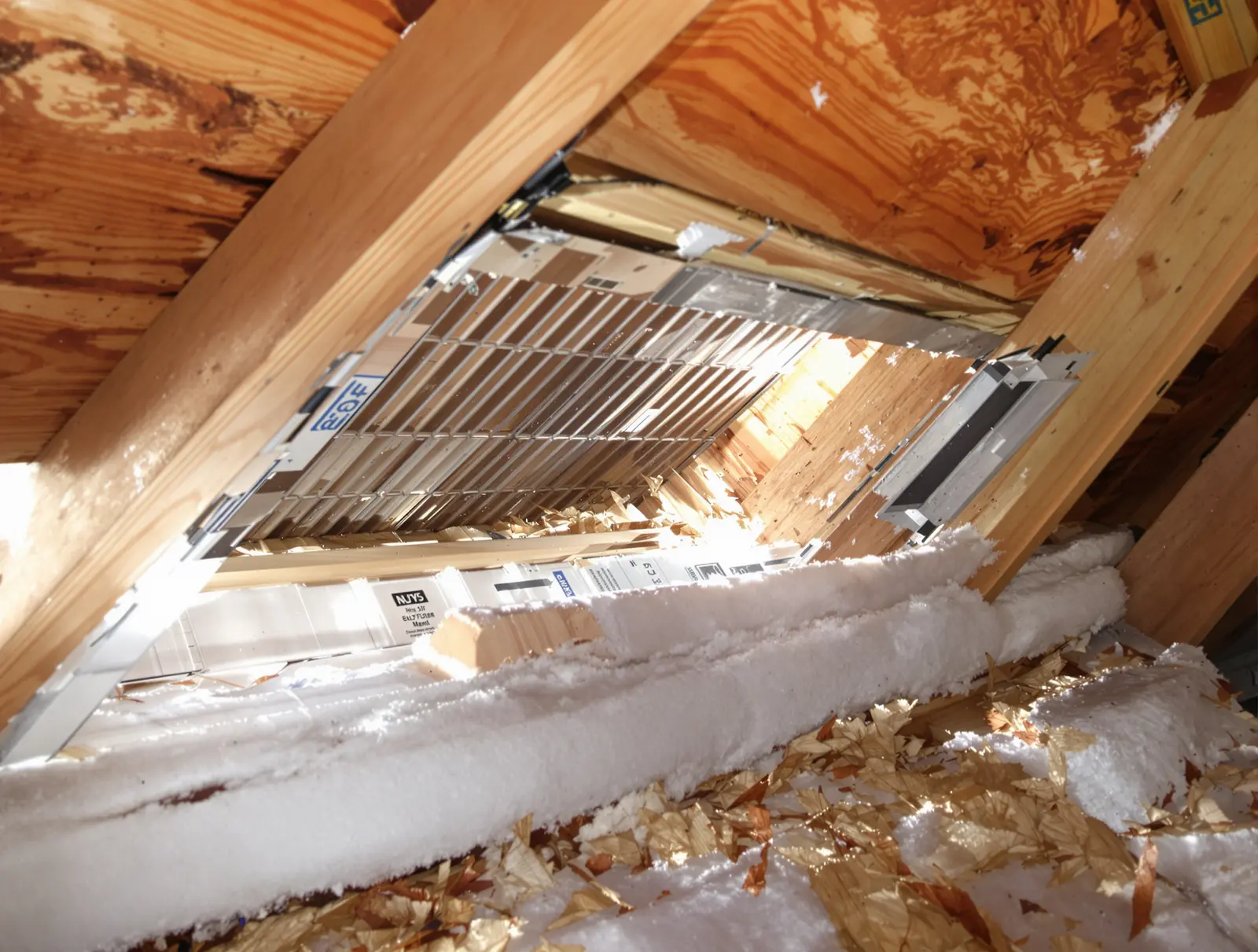
Slide the baffle into the rafter bay with the curved side facing up (toward the roof sheathing). Position it so the bottom edge sits at or just above the soffit vent opening. The baffle should extend at least 18-24 inches up the rafter bay, past where the insulation could slide back. Staple or press-fit the flanges against the inside face of each rafter.
The baffle creates a permanent air channel. Air enters through the soffit vent, travels up the channel between the baffle and the roof sheathing, and enters the open attic space above the insulation. The baffle prevents insulation from ever sliding back over the vent.
Step 8: Replace Insulation Behind the Baffle
Push insulation back into the rafter bay behind the baffle. Fill the space between the baffle and the ceiling drywall below. The insulation should be snug but not compressed — compressed insulation loses R-value. Make sure insulation covers the top plate of the exterior wall, which is a common thermal bypass point.
Checkpoint: After installing baffles, verify:
- Each baffle is seated against the roof sheathing with flanges touching the rafters
- Daylight is visible through the soffit vent below each baffle
- Insulation fills the space behind the baffle without blocking the air channel
- Insulation covers the top plate of the exterior wall
Step 9: Verify Airflow from Outside
After completing the interior work, go outside and check each soffit vent. Hold a tissue or lightweight piece of paper near the soffit vent opening. On a warm day (when the attic is warmer than outside air), you should feel a slight pull as air is drawn into the soffit. If the tissue does not move, recheck that bay from inside the attic.
Why baffles are better than just clearing the insulation. Without a baffle, cleared insulation will migrate back over the soffit within 6-18 months. Wind washing (air movement along the eave) pushes loose insulation around. Gravity pulls batt insulation downhill toward the eave. Temperature cycling causes insulation to settle and shift. A baffle is a permanent fix for a recurring problem.
Baffle material options: Foam baffles (Durovent, AccuVent) are the most common and cheapest at $1-2 each. Rigid plastic baffles are more durable at $2-3 each. Some builders use site-cut rigid foam board. All work — the key is that the baffle stays in place and creates a minimum 1-inch air channel (2 inches is better).
Think about it...
After installing baffles, you notice that the insulation in several bays does not reach the top plate of the exterior wall — there is a gap of exposed wood below the insulation. Is this a problem?
Common Mistakes to Avoid
Mistake #1: Clearing insulation without installing baffles. This works temporarily but fails within a year. Insulation drifts back. Always install baffles to make the fix permanent.
Mistake #2: Compressing insulation to make room for the baffle. Squeezing R-30 insulation into half its thickness drops it to approximately R-15. Position the baffle against the roof sheathing and let the insulation fill its natural depth behind it. If the rafter bay is too shallow for full-depth insulation plus an air channel, use the baffle against the sheathing and accept the reduced insulation depth at the eave — the airflow is more important than maximum R-value in the last 18 inches.
Mistake #3: Blocking the vent from outside. Some homeowners accidentally cover soffit vents when painting, installing new siding, or adding pest screening. If you are having exterior work done, tell the contractor explicitly to keep soffit vents open. After the work, verify airflow from inside the attic.
Mistake #4: Installing baffles in only some bays. Every rafter bay at the eave needs a baffle. If you skip bays, those bays will block again and create dead zones. For a typical Gulf Coast home, you need 30-60 baffles — budget for the complete set.
When Blocked Soffits Need a Professional
Some blockages are not insulation problems. If your soffits are physically sealed — painted shut, covered by solid vinyl siding panels with no perforations, or filled with wood blocking — the fix requires cutting new vent openings from outside. This is a carpentry job, not an insulation job, and typically costs .
Extremely tight attic spaces may require professional help. If you cannot safely reach the eaves — the space narrows to less than 18 inches between the joists and the roof sheathing — an insulation contractor has the tools and experience to work in confined spaces. Some contractors use specialized blowing equipment with long hoses to install baffles in spaces too tight to crawl into.
If you find moisture damage, mold, or compressed/wet insulation near the eaves, stop the DIY work and get a professional assessment. These conditions indicate a moisture problem that may have causes beyond blocked soffits — leaking soffits, failed flashing, or a bathroom fan venting into the attic. Address the moisture source before improving ventilation.
Frequently Asked Questions
How do I know if my soffit vents are blocked?
Go into the attic with a flashlight and look at the eave area where the roof meets the exterior walls. If you cannot see daylight through the soffit vents, or if insulation is piled up against the roof sheathing at the eaves, your soffits are blocked. You can also go outside and hold a tissue near the soffit vent — if it does not move, there is no airflow.
Can I clear blocked soffits myself?
Yes, in most cases. If the blockage is blown-in insulation that has migrated over the vents, you can pull it back by hand and install rafter baffles ($1-3 each) to keep it in place. You need a flashlight, dust mask, knee pads, and the baffles. The work takes 2-4 hours for a typical home. If the soffits are physically sealed (painted over or covered with siding), you may need a contractor to cut new openings.
What are rafter baffles and why do I need them?
Rafter baffles (also called vent chutes or insulation stops) are lightweight foam or plastic channels that staple between the rafters at the eave. They create a permanent air channel from the soffit vent into the attic, preventing insulation from sliding back over the vent opening. Without baffles, cleared soffits will eventually block again as insulation settles.
How many soffit vents should my house have?
You need enough soffit NFA (net free area) to equal at least 50% of your total required ventilation. For a 1,500 sq ft attic at the 1:150 ratio, you need 10 sq ft of total ventilation — 5 sq ft at the soffits. A standard 16x8 inch soffit vent provides about 0.45 sq ft of NFA, so you would need approximately 11 vents spaced evenly around the eaves.
My house has continuous soffit vents — can those get blocked too?
Absolutely. Continuous soffit strips have more total NFA than individual vents, but they are just as vulnerable to insulation blockage from inside the attic. They can also get painted over, clogged with dirt and wasp nests from outside, or covered when new siding is installed. Check them the same way — look for light and airflow from inside the attic.
What to do next
Quick recap
Blocked soffit vents are the most common ventilation failure and one of the cheapest to fix. Installing rafter baffles at $1-3 each makes the fix permanent.
Your next step
Grab a flashlight and check your soffits this morning before the attic heats up. Look for daylight at the eaves — if you can't see any, your soffits are blocked.
Keep reading