If your ductwork runs through the attic — and in most Gulf Coast homes, it does — your AC system is fighting a battle it cannot win. Supply air at 55°F gains 15-25°F passing through a 130-150°F attic, arriving at the register at 70-80°F instead of 55°F. Add 20-30% air loss through leaky connections, and your AC runs 30-50% longer than it should. This is NOT a roofing problem. It is an HVAC problem, and the fix — duct sealing and insulation — is one of the best energy investments available.
After reading this page, you'll understand why attic ductwork causes comfort and energy problems, how to check your ducts, and what the fixes cost relative to their payback.
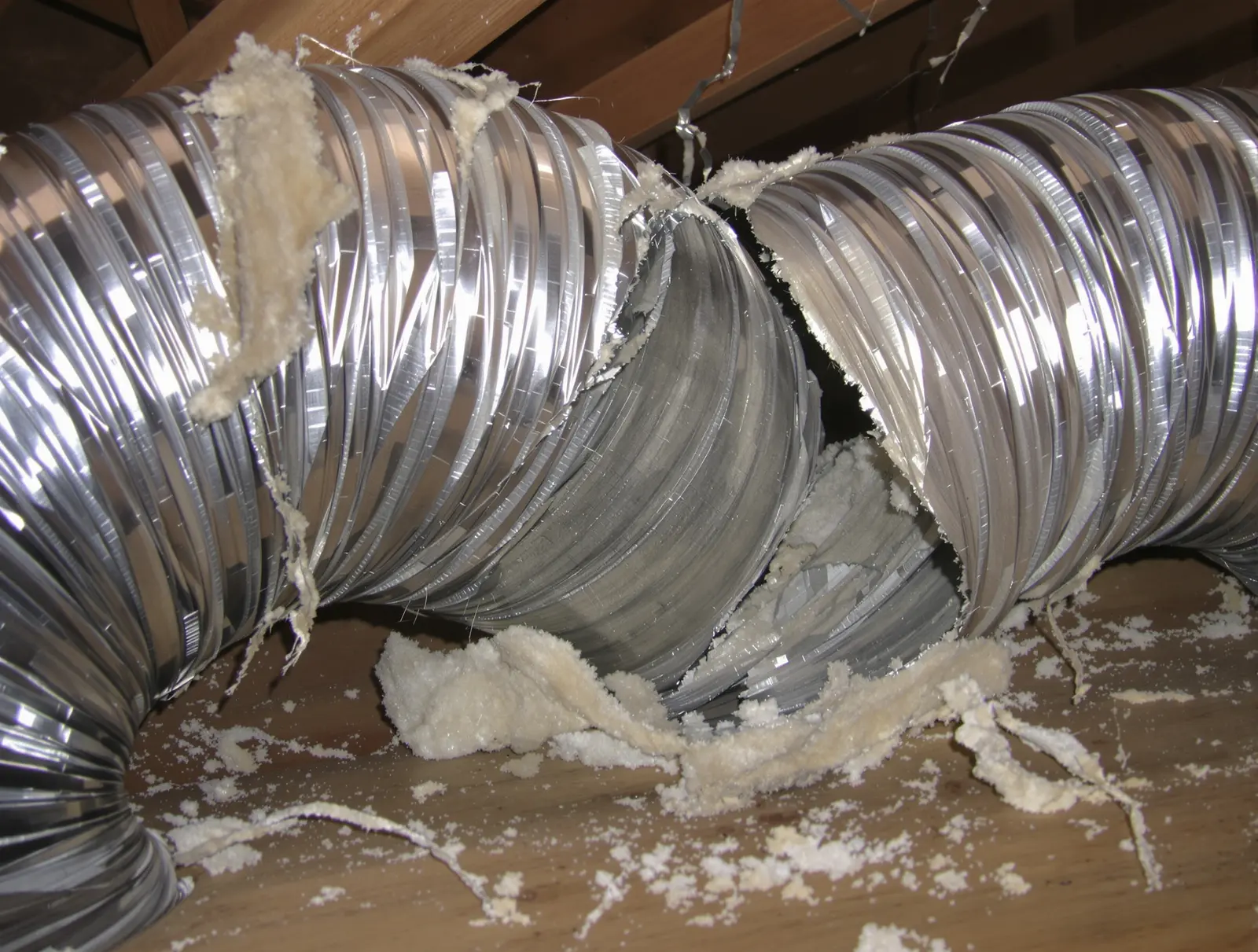
The Core Problem: Cold Air in a Hot Box
Your AC produces supply air at 55-60°F. That air travels through ductwork — typically flex duct or sheet metal — from the air handler to the supply registers in each room. In a well-designed system, the air arrives at the register within a few degrees of its starting temperature.
On a 95°F Gulf Coast summer day, the attic reaches 130-150°F. The ductwork running through that space is surrounded by air that is 70-95 degrees hotter than the air inside the duct. Even with R-6 duct insulation (the code minimum), the supply air gains 15-25°F during its journey through the attic. Instead of 55°F air reaching the register, you get 70-80°F air — a difference you can confirm in minutes with the supply register temperature test.
That 15-25°F temperature gain has cascading effects. The air arriving at the register has less cooling capacity. The rooms do not cool as quickly. The thermostat keeps calling for cooling. The AC runs longer — 30-50% longer in many Gulf Coast homes. The longer runtime increases electricity costs, accelerates equipment wear, and reduces the system's ability to dehumidify (short cycling reduces dehumidification; long runtime helps dehumidification but at higher energy cost).
The temperature gain is worse for rooms farthest from the air handler. The longer the duct run, the more heat the air absorbs. This is why the master bedroom at the far end of the house is often the hottest room — its supply air traveled the longest path through the hottest space. Learn why one room is always hotter.
Common misconception:
If my AC is sized correctly, the ductwork location shouldn't matter.
Gulf Coast reality:
Correct AC sizing assumes the system delivers its rated capacity to the rooms. When ducts in a 150°F attic lose 15-25°F of cooling and leak 20-30% of airflow, a correctly sized 3-ton system delivers the equivalent of a 2-ton system. The sizing is right but the delivery system is sabotaging it. Many homeowners upgrade to a larger AC when the real problem is the ductwork.
The Two Ductwork Problems: Heat Gain and Air Loss
Problem 1: Heat gain through the duct walls (conduction). Even a perfectly sealed duct with intact insulation gains heat from the surrounding attic air. The rate of heat gain depends on the insulation R-value, the temperature difference (attic vs. supply air), and the duct surface area. With R-6 insulation in a 140°F attic, a typical duct run gains 10-15°F. With damaged or missing insulation, it gains 20-30°F.
Problem 2: Air loss through leaky connections (leakage). Every duct connection — where flex duct meets the trunk, where trunk connects to a register boot, where the air handler connects to the plenum — is a potential leak point you can inspect with a flashlight and your hands. The average home loses 20-30% of conditioned air through these connections. That 55°F air escapes into the 140°F attic, cooling the attic slightly (wasted energy) while the rooms below get less airflow.
Both problems act simultaneously and compound each other. The air that does make it through the duct is warmer (heat gain). There is less of it (leakage). The combined effect can reduce the delivered cooling capacity by 30-50% compared to a sealed, well-insulated system in conditioned space.
Think about it...
A homeowner has a 3-ton AC system (36,000 BTU/hr nominal cooling). Their ducts lose 25% of airflow to leakage and the remaining air gains 20°F passing through the attic. Roughly how much cooling capacity actually reaches the rooms?

The Hidden Problem: Duct Condensation
Ductwork in the attic is also a moisture problem, not just an energy problem. Supply ducts at 55-60°F are well below the Gulf Coast summer dew point of 72-78°F. Any section of duct where the insulation is missing, torn, or compressed exposes a cold metal surface to humid attic air. Condensation forms immediately.
The condensation drips. It drips off the duct onto the insulation below, saturating it. Over time, the wet insulation develops mold and loses R-value. In severe cases, the water soaks through the insulation and stains the ceiling drywall, mimicking a roof leak. Many homeowners call a roofer for what is actually a duct condensation problem. Learn how to distinguish the two.
Leaky return ducts create a different moisture pathway. A return duct with gaps pulls hot, humid attic air into the HVAC system. This humid air increases the moisture load on the evaporator coil, potentially overwhelming the condensate drain system. It also means the AC is dehumidifying attic air instead of just the living space — a hidden energy penalty.
The condensation math for Gulf Coast ducts. A supply duct at 58°F in an attic with 78°F dew point air has a 20°F condensation margin — any exposed surface will condense moisture aggressively. One linear foot of 8-inch duct with missing insulation can condense approximately 0.1 pints of water per hour. A typical system with 5-10 feet of exposed duct surface (torn insulation, unsealed joints) can condense 0.5-1.0 pints per hour — 8-16 pints during a 16-hour AC runtime day. Over a summer, that is hundreds of gallons of water dripping into the attic.
Duct condensation is self-reinforcing. Wet duct insulation loses R-value as the fiberglass becomes saturated. Lower R-value means more heat gain into the duct (warmer supply air) AND more condensation on the outer surface (colder duct relative to its wet insulation). The insulation never dries during cooling season because it is continuously wet. Once this cycle starts, the only fix is replacing the insulation entirely.
Signs Your Ductwork Is Costing You Money
You do not need to enter the attic to suspect a duct problem. These symptoms are detectable from inside the living space.
- Rooms far from the air handler are significantly warmer. If the master bedroom at the end of the duct run is 3-5°F warmer than rooms near the air handler, duct heat gain or leakage is likely.
- Weak airflow at supply registers. Hold a tissue near each supply register when the AC is running. Strong, steady airflow means the duct connection is intact. Weak or absent airflow suggests a disconnected duct or major leak upstream.
- Supply air feels warm. Hold a thermometer at the supply register closest to the air handler and at the farthest register. The close register should read 55-60°F. If the far register reads above 70°F, the duct is gaining too much heat.
- High energy bills despite a properly sized AC. If your system was correctly sized but your cooling bills are 30-50% higher than neighbors with similar homes, duct losses are a primary suspect.
- Water stains on the ceiling below ductwork. Condensation dripping from ducts can stain ceiling drywall. The stains often appear in lines following the duct path — different from a roof leak, which typically shows at a single point. Learn about attic moisture sources.
The 5-minute supply register temperature test confirms the problem quantitatively. All you need is a thermometer and 5 minutes. Take the supply register temperature test.
Think about it...
You measure the supply air temperature at the register closest to the air handler: 58°F. The register in the master bedroom (farthest room, longest duct run) reads 74°F. What does this 16°F difference tell you?
How Common Is This Problem?
Extremely common on the Gulf Coast. An estimated 80-90% of single-family homes in Mississippi, Alabama, and the Florida Panhandle have HVAC ductwork in the attic. This is the dominant construction practice in the region because slab-on-grade foundations (the standard in coastal areas) eliminate the basement and crawl space options used in other regions.
Of those homes, Energy Star estimates that the average duct system loses 20-30% of conditioned air through leaks. Combined with heat gain through inadequate or damaged insulation, the typical Gulf Coast home is delivering only 50-70% of its AC system's rated capacity to the living space. The other 30-50% is wasted heating the attic.
Ductwork condition degrades over time. Connections loosen as materials expand and contract through daily 50-70°F temperature cycles. Insulation compresses where it contacts joists and other surfaces. Tape used at connections dries out and releases in attic heat. Flex duct sags between supports, restricting airflow and creating condensation pools. A duct system that was adequate when installed can lose significant performance over 10-15 years without maintenance.
What You Can Do About It
The good news: duct sealing and insulation is one of the most cost-effective energy improvements available. It is cheaper than a new AC, cheaper than a new roof, and often pays for itself in 1-3 years through reduced energy costs.
Option 1: DIY duct inspection and minor sealing. Enter the attic (morning only, before 10 AM) and visually inspect the ductwork. Look for disconnected joints, torn insulation, and sagging flex duct. Reconnect loose joints and seal with mastic ( ). This addresses the most obvious leaks. Follow the duct inspection guide.
Option 2: Professional duct sealing and insulation ($500-1,500). An HVAC technician performs a duct leakage test (duct blaster), seals all connections with mastic — including connections inside the air handler cabinet that you cannot reach — and replaces damaged insulation. They test again after sealing to verify improvement. This is the recommended approach for thorough results. See the complete duct sealing guide.
Option 3: Duct replacement ($3,000-7,000). If the existing ductwork is severely deteriorated — crushed flex duct, extensive mold on duct surfaces, widespread insulation failure — replacement may be more cost-effective than repair. A new duct system with R-8 insulation and properly sealed connections performs dramatically better than a patched old system.
Common misconception:
Duct tape is the right product for sealing ductwork.
Gulf Coast reality:
Standard 'duct tape' (cloth-backed adhesive tape) fails within 1-5 years in attic conditions. The adhesive dries out and releases at temperatures above 140°F — temperatures your attic reaches daily in summer. Use UL-181 rated mastic (a thick paste applied with a brush or gloved hand) for all duct sealing. Mastic is permanent, stays flexible, and does not degrade in heat.
The Cost-Benefit Case
Professional duct sealing at $500-1,500 typically saves $150-400 per year on cooling costs. The payback period is 1-3 years — faster than almost any other home energy improvement. By comparison, a new roof costs $8,000-15,000 and saves $100-300 per year on cooling (if switching to a cool roof). Our complete duct sealing guide covers what the process involves and how to evaluate contractor quotes — it delivers more savings per dollar spent than any roofing improvement.
This is why the energy priority ranker often ranks duct sealing above roof improvements. If your ducts are leaking 25% of conditioned air into a 140°F attic, fixing the ducts delivers more immediate comfort and savings than changing the roof color or adding a radiant barrier. Run the energy priority ranker to see where duct sealing ranks for your home.
Duct sealing also extends AC equipment life. When the system runs 30-50% less because it is delivering its full capacity, the compressor, blower motor, and other components accumulate fewer runtime hours. A system that would have lasted 12 years may last 15-18 years with properly sealed ducts.
Frequently Asked Questions
Why is ductwork in the attic such a big problem?
Because the attic is the worst possible environment for cold air delivery. On a 95°F Gulf Coast day, the attic reaches 130-150°F. Supply ducts carrying 55°F air through that space gain 15-25°F before reaching the register — meaning 70-80°F air comes out instead of 55°F. The AC has to run much longer to compensate, increasing energy costs by 20-40% in many homes.
What percentage of conditioned air is lost through duct leaks?
The average home loses 20-30% of conditioned air through duct leaks, according to Energy Star. In Gulf Coast homes with attic ductwork, this percentage can be higher due to heat-accelerated deterioration of duct connections and insulation. A well-sealed duct system loses less than 10% — meaning a typical home has a 10-20% improvement opportunity.
Is it better to move the ductwork out of the attic?
If you are building new or doing a major renovation, yes — running ducts inside the conditioned space (below the ceiling, in soffits, or in a dropped ceiling) eliminates heat gain and condensation problems entirely. For existing homes, this is usually cost-prohibitive ($5,000-15,000+). Sealing and insulating the existing attic ducts is far more practical and still delivers significant savings.
Can I seal ductwork myself?
Minor sealing — applying mastic to accessible joints and reconnecting loose flex duct — is manageable as a DIY project. Materials cost $30-75. However, a thorough duct sealing job includes testing the system with a duct blaster (a diagnostic tool that measures total duct leakage), sealing connections inside the air handler cabinet, and verifying airflow balance after sealing. This level of work requires an HVAC professional.
Does duct sealing qualify for any rebates or tax credits?
Duct sealing may qualify for utility rebates from your local power company (check with Mississippi Power, Alabama Power, or Gulf Power). The federal 25C tax credit covers certain energy efficiency improvements including duct sealing when performed by a qualified contractor with pre/post testing. The credit covers up to 30% of the cost. Consult a tax professional for current eligibility.
How long does professional duct sealing take?
A typical whole-house duct sealing job takes 4-8 hours for a single HVAC system. This includes initial duct leakage testing, sealing all accessible connections with mastic, reconnecting any separated joints, replacing damaged insulation sections, and post-sealing leakage testing to verify improvement. Most jobs are completed in a single day.
What to do next
Quick recap
Ductwork in the attic loses 15-25°F of cooling through heat gain and 20-30% of airflow through leaks. The combined effect reduces your AC's delivered capacity by 30-50%. Duct sealing at $500-1,500 typically pays for itself in 1-3 years — one of the best energy investments available.
Your next step
Take the 5-minute supply register temperature test to see how much cooling your ducts are losing right now.