This 5-minute test tells you exactly how much cooling your ductwork is losing in the attic. Hold a thermometer at the supply register closest to the air handler (expected: 55-60°F) and at the farthest register. The difference is your duct temperature rise — the heat the attic is adding to your supply air. A rise of 2-5°F is normal. A rise of 10°F or more means your ducts are costing you real money. All you need is a thermometer.
After this 5-minute test, you'll have a specific number that tells you whether duct sealing should be your next home improvement priority.
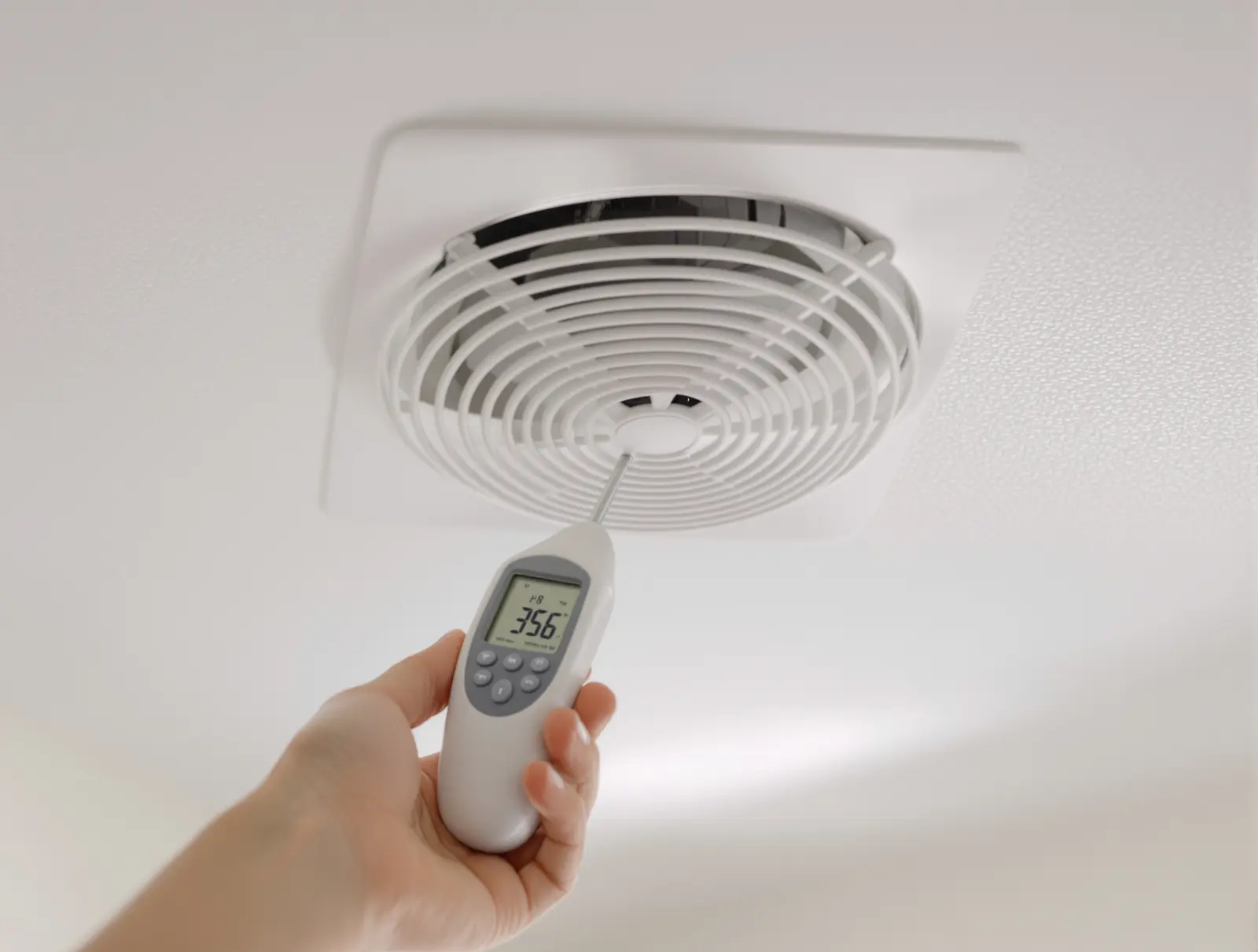
What This Test Reveals
The supply register temperature test measures the performance of your duct delivery system. Your AC produces supply air at 55-60°F. That air travels through ductwork in the attic — surrounded by 130-150°F air on a Gulf Coast summer day — before reaching the registers in each room. The temperature at the register tells you how much heat the air absorbed during that trip.
A well-insulated, sealed duct system adds 2-5°F to the supply air. The register closest to the air handler reads 56-58°F. The farthest register reads 58-63°F. The air arrives cold enough to cool the room effectively.
A poorly insulated or leaky duct system adds 10-25°F. The far register reads 68-80°F — barely cooler than room temperature. That air has almost no cooling capacity left. The room stays warm. The AC runs all day. The energy bills climb. Learn why attic ductwork is such a problem.
This test costs nothing but 5 minutes of your time. A thermometer you already own (kitchen, cooking, or digital probe) is all you need. The result gives you a specific, actionable number — not a vague sense that something might be wrong.
Common misconception:
If cold air comes out of the register, the duct system is working fine.
Gulf Coast reality:
'Cold' is relative. Air at 70°F feels cool to your hand if the room is 78°F, but it has lost 15°F of its cooling capacity in the duct. That register is delivering half the cooling it should. The supply register temperature test gives you the exact number instead of a subjective 'feels cool' assessment. Many homeowners are surprised to find their 'cold' registers are actually delivering 68-72°F air.
What You Need
One thermometer. That's it. Options:
- Digital probe thermometer ( ) — Best option. Fast, accurate, easy to hold in the airstream.
- Kitchen/cooking thermometer — Works fine. Hold in the airstream for 60 seconds to stabilize.
- Infrared thermometer ( ) — Less precise for this test because it reads the grille surface temperature, not the air temperature. Works for a rough check.
You do NOT need to enter the attic for this test. Everything happens inside the living space at the supply registers. This makes it a safe test you can do any time of day, even during the heat of a Gulf Coast summer afternoon — which is actually the best time to test because the attic is at peak temperature.
Step-by-Step: The 5-Minute Test
Step 1: Let the AC Run for 15 Minutes
Set your thermostat 5°F below the current room temperature. This ensures the system runs continuously during your test rather than cycling off. You need steady-state operation — the system at full capacity for at least 15 minutes — so the supply air temperature stabilizes. If the system has been running continuously already (hot summer afternoon), you can skip the wait.
Step 2: Measure the Closest Register
Find the supply register closest to the air handler. In most Gulf Coast homes, this is in the hallway or a room near the center of the house, directly below the attic-mounted air handler. Hold the thermometer probe in the center of the airstream, about 1 inch from the register face. Wait 60 seconds for the reading to stabilize. Record the temperature.
Expected reading: 55-60°F. This is your baseline — the temperature of air that has traveled the shortest distance through the attic. If this register reads above 62°F, the problem may be the AC system itself (low refrigerant, dirty coil) rather than the ductwork. Learn about AC performance issues.
Step 3: Measure the Farthest Register
Find the supply register farthest from the air handler. This is typically in the master bedroom, a back bedroom, or whichever room has the longest duct run through the attic. Measure the same way — probe in the airstream, 60 seconds, record the temperature.
Expected reading: 58-65°F. A well-insulated, sealed duct system shows a rise of 2-5°F from the closest to the farthest register. Higher readings indicate heat gain (poor insulation) or air loss (leaky connections) along that duct run.
Step 4: Measure 2-3 Middle Registers
Test 2-3 registers at intermediate distances from the air handler. This reveals whether the temperature rise is gradual (insulation issue — heat seeping in along the entire run) or sudden (a specific leak or disconnection at one point along the duct). Record each temperature and note the room.
Checkpoint: You should now have 4-5 temperature readings.
- Closest register to air handler: ___°F
- Middle register 1: ___°F (room: ___)
- Middle register 2: ___°F (room: ___)
- Farthest register from air handler: ___°F
- Temperature rise (farthest minus closest): ___°F
Check Yours: Supply Temperature Assessment
Enter the temperature you measured at your farthest supply register (with the AC running for at least 15 minutes).
Think about it...
You get these readings: closest register 57°F, hallway 59°F, guest bedroom 62°F, master bedroom 73°F. What does the jump from 62°F to 73°F suggest?
Interpreting Your Results
Temperature Rise: 0-5°F — System Performing Well
Your ductwork is in good condition. The insulation is intact and connections are reasonably sealed. The air arriving at your registers has most of its cooling capacity. No duct work needed. Consider checking other comfort factors if you still have issues: take the cause finder diagnostic.
Temperature Rise: 5-10°F — Moderate Heat Gain
Your ducts are losing some cooling capacity but not catastrophically. This range typically indicates aging duct insulation that has compressed at contact points, minor air leaks at connections, or a combination of both. The energy penalty is real but moderate — roughly 10-15% additional cooling cost.
Recommended action: Visual inspection of the ductwork when convenient. Seal any obvious leaks with mastic. Consider professional duct sealing if you are also experiencing comfort problems or high energy bills. Follow the duct inspection guide.
Temperature Rise: 10-15°F — Significant Heat Gain
Your duct system is losing substantial cooling capacity. Expect 20-30% higher cooling costs than a well-sealed system. Common causes: multiple leaky connections, sections of missing or severely damaged insulation, or a disconnected branch duct dumping conditioned air into the attic.
Recommended action: Enter the attic for a visual inspection as soon as conditions allow. Check for disconnected ducts, torn insulation, and sagging flex duct. Professional duct sealing ( ) is strongly recommended at this level. The payback period at this severity is typically 1-2 years. Read the duct sealing guide.
Temperature Rise: 15°F or More — Severe Problem
Your duct system is severely compromised. The far register is delivering air with minimal cooling capacity. Expect 30-50% higher cooling costs. This level of temperature rise usually indicates a disconnected duct somewhere along the run, extensive insulation failure, or both.
Recommended action: Inspect the attic ductwork immediately (morning only). A disconnected duct means a room is getting zero cooling while conditioned air blows into the attic. This is the most urgent duct problem and also the most impactful to fix. Professional duct sealing and possible duct replacement should be scheduled. At this severity, every month of delay costs $50-100+ in wasted energy.
Converting temperature rise to dollars. Each degree of temperature rise at the far register roughly correlates with a 2-3% increase in cooling cost for that zone. A 15°F rise translates to approximately 30-45% more energy used to cool the rooms served by the worst-performing ducts. For a home spending $200/month on cooling (common on the Gulf Coast), that is $60-90/month in duct-related waste — $360-540 over a 6-month cooling season.
The supply temp test is a proxy for duct system efficiency, not a precise measurement. Temperature rise correlates strongly with duct performance, but airflow volume matters too. A duct with no temperature rise but severe airflow restriction (kinked or crushed flex duct) also delivers poor cooling. If your temperature readings look normal but a room is still warm, check airflow by holding a tissue at the register — weak airflow indicates a restriction rather than a heat gain problem.
What This Test Cannot Tell You
The supply temp test does not distinguish between heat gain and air leakage. A register reading 72°F could mean the duct insulation is missing (heat gain through the duct wall) or that 40% of the air leaked out through a disconnected joint (the remaining air absorbed heat from the reduced airflow). Both produce the same register temperature. An attic inspection or professional duct blaster test is needed to determine which problem is dominant.
The test does not assess return duct leakage. Leaky return ducts pull hot, humid attic air into the HVAC system, increasing the cooling and dehumidification load. This does not show up as a warm supply register — it shows up as higher humidity in the house and higher energy bills. Return leaks require a professional duct blaster test to quantify.
The test does not assess the AC system's output. If the closest register reads above 62°F, the problem may be the AC itself (low refrigerant, dirty coil, failing compressor) rather than the ductwork. The duct system cannot deliver cold air if the AC is not producing it. Have the AC checked before pursuing duct work if your closest register is warm.
Think about it...
Your closest register reads 58°F and your farthest reads 59°F — a rise of only 1°F. But the farthest room is still uncomfortably warm. What else could be wrong?
Frequently Asked Questions
What temperature should air be at the supply register?
In a well-functioning system, supply air should be 55-60°F at the register closest to the air handler, and no more than 62-65°F at the farthest register. Air above 70°F at any register indicates significant heat gain or duct leakage between the air handler and that register.
Does it matter when I do the test?
Yes. Run the test during the afternoon on a hot day (outdoor temperature above 90°F) when the attic is at peak temperature. This tests the worst-case scenario — maximum heat gain through the ductwork. A duct that performs adequately in the morning when the attic is 90°F may fail badly when the attic hits 145°F in the afternoon.
Can I use any thermometer for this test?
A standard kitchen/cooking thermometer works if you hold it in the airstream at the register for 60 seconds. A digital probe thermometer gives a faster, more accurate reading. An infrared thermometer pointed at the register grille gives an approximate reading of the grille temperature rather than the air temperature — it works but is less precise than a probe in the airstream.
What if all my registers show warm air, even the one closest to the air handler?
If the closest register also shows warm air (above 62°F), the problem may be the AC system itself rather than the ductwork. Low refrigerant charge, a dirty evaporator coil, or a failing compressor can reduce cooling output at the source. Have an HVAC technician check the system. The duct system cannot deliver cold air if the AC is not producing it.
My far register shows 72°F. How much is that costing me?
Air at 72°F has minimal cooling effect in a room where the thermostat is set to 74°F. That register is essentially delivering no useful cooling to that room, which means the AC runs longer to compensate. The rough energy penalty: for every 5°F of duct temperature rise, cooling efficiency drops approximately 10-15%. A 17°F rise (55°F to 72°F) suggests 30-50% of the cooling capacity for that room is lost in the duct.
What to do next
Quick recap
The supply register temperature test takes 5 minutes and requires only a thermometer. A temperature rise of 2-5°F is normal. A rise of 10°F or more means your ducts are losing significant cooling capacity and duct sealing should be a priority. A rise of 15°F+ is urgent — you may have a disconnected duct.
Your next step
Grab a thermometer and test your registers right now. Start with the closest register to get your baseline, then check the farthest room.