Heat travels from your roof to your living space through four distinct pathways: conduction through the roof deck, radiation from the hot deck to attic contents, convection of superheated attic air, and heat absorption by ductwork. In most Gulf Coast homes, duct heat absorption and radiation cause more comfort problems than hot air alone — which is why ventilation alone rarely solves a hot-house problem.
After reading this page, you'll understand each pathway well enough to identify which ones are active in your own attic and which improvements target each one.
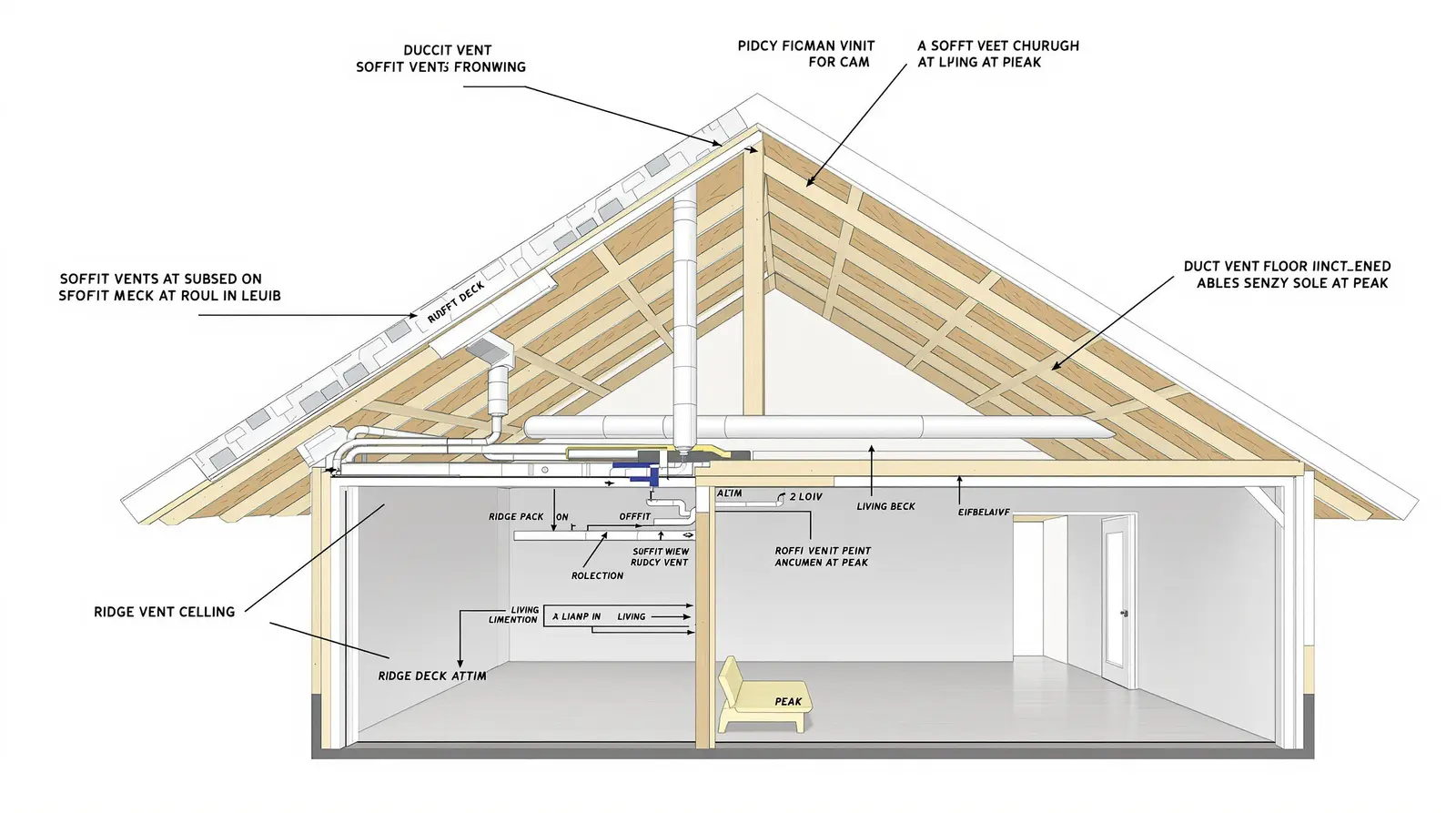
Four Pathways, Four Different Fixes
Solar energy hits your roof at roughly 250-300 BTUs per square foot per hour on a Gulf Coast summer afternoon. A 2,000-square-foot dark shingle roof absorbs 85-95% of that energy, heating the surface to 155-170°F. That thermal energy does not stay on the roof surface. It moves downward through four pathways, each governed by different physics, each requiring a different intervention.
Most homeowners think of attic heat as a single problem — hot air in the attic. They assume that if you cool the air (ventilation) or block the air (insulation), the problem is solved. In reality, only one of the four pathways involves hot air. The others operate through solid materials and electromagnetic radiation, which ventilation and standard insulation address only partially.
The relative importance of each pathway depends on your home's specific configuration. A home with ductwork in the attic has a major vulnerability that a home with ducts in interior walls does not. A home with R-38 insulation is better protected against conduction but still exposed to radiation heating the insulation surface. Identifying which pathways are most active in your attic tells you exactly where to focus improvement efforts.
Heat Flow Simulator
Toggle settings to see how heat moves from roof to living space.
A dark roof with no insulation, no ventilation, and no radiant barrier allows maximum heat transfer. Living space reaches approximately 85°F.
Pathway 1: Conduction Through the Roof Deck
Conduction is heat moving through solid material by direct contact. When the roof surface reaches 165°F, that energy conducts through the shingles, through the underlayment, and into the plywood or OSB deck. The deck's interior surface reaches within 5-15°F of the exterior surface temperature. On a standard dark shingle roof, the interior deck surface hits 145-160°F by mid-afternoon.
The speed of conduction depends on material thickness and thermal conductivity. Asphalt shingles are thin (approximately 3/16 inch) and moderately conductive, so heat moves through them in minutes. The plywood or OSB deck (typically 7/16 to 3/4 inch) adds some delay but not much. From the moment peak solar radiation hits the roof to the moment the deck interior reaches its peak temperature, you are looking at 30-60 minutes of lag time.
Metal roofing conducts heat faster than asphalt, but this is not the whole story. Metal has higher thermal conductivity than asphalt, which sounds like a disadvantage. However, metal's higher reflectance means it starts at a lower temperature, and when installed over battens with an air gap, the conducted heat enters a ventilated space rather than direct contact with the deck. Net result: less heat reaches the deck interior despite faster conduction through the metal itself.
What interrupts conduction: insulation at the attic floor. Standard fiberglass batt or blown-in insulation resists conductive heat flow. The R-value rating is specifically a measure of resistance to conduction. R-30 insulation between a 145°F attic and a 75°F room limits conductive heat transfer to approximately 2.3 BTU per square foot per hour. R-11 insulation allows 6.4 BTU per square foot per hour — nearly three times as much.
The thermal conductivity (k-value) of common roof deck materials: Plywood has a k-value of about 0.80 BTU·in/(hr·ft²·°F). OSB is similar at approximately 0.74. For comparison, steel (used in metal roofing) has a k-value of 314 — roughly 400 times higher. But because metal roofing is much thinner (26-29 gauge, or 0.016-0.019 inches) than a plywood deck (0.4375-0.75 inches), the total thermal resistance is comparable. The real performance difference comes from reflectance and emittance, not conductivity.
Pathway 2: Radiation from the Hot Deck
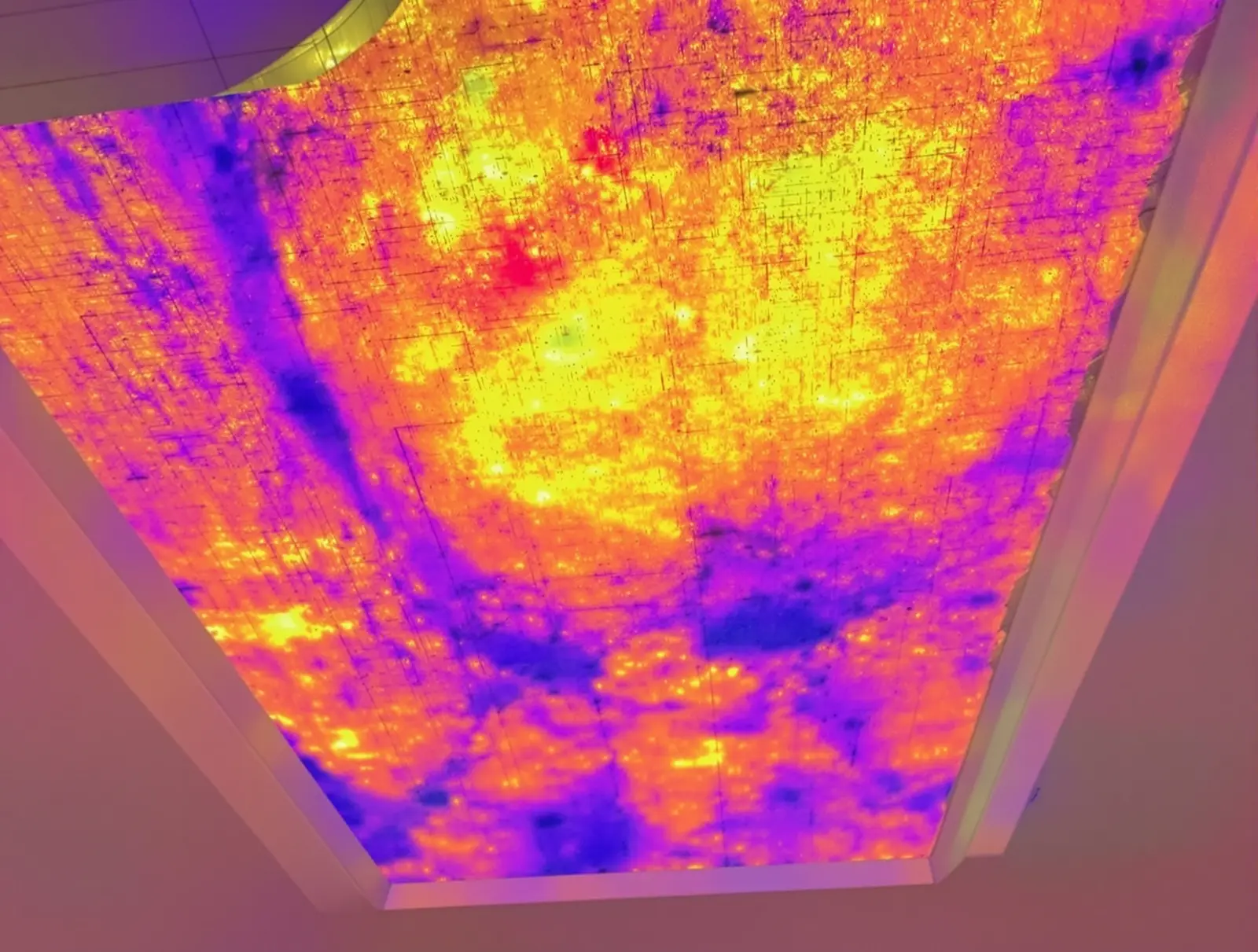
Radiation is the transfer of heat through electromagnetic waves, and it is the dominant pathway in most attics. The interior surface of a 150°F roof deck radiates infrared energy downward to every surface it can "see" — the top of insulation, ductwork, framing, stored items, and the attic floor. This energy transfer happens at the speed of light and requires no air or physical contact. Removing the air (as in a vacuum) would not stop it.
The amount of radiant energy is proportional to the temperature difference raised to the fourth power. This means small increases in deck temperature produce large increases in radiant output. A deck at 160°F radiates approximately 35% more energy than a deck at 140°F. This is why even modest reductions in roof surface temperature — from a cool-rated shingle or lighter color — produce outsized reductions in attic heat loading.
Radiant energy heats the top surface of insulation to temperatures far above the attic air temperature. Even in a well-ventilated attic where air temperature is 120°F, the insulation surface directly below the roof peak may reach 135-140°F from radiant heating. This elevated surface temperature reduces the effective temperature difference across the insulation and increases heat flow into the room below.
What interrupts radiation: radiant barriers. A radiant barrier — a sheet of aluminum foil or foil-faced material installed in the attic — reflects 95-97% of radiant energy back toward the roof deck. Florida Solar Energy Center research shows radiant barriers reduce ceiling heat gain by 16-42% depending on insulation level and installation method. They are most effective when installed on the underside of rafters and when existing insulation is thin.
Think about it...
Your attic has R-38 insulation and a ridge vent system that keeps attic air at 115°F. But the ceiling below still feels warm to the touch. What pathway is most likely responsible?
Pathway 3: Convection of Hot Attic Air
Convection is heat carried by moving air, and it is the most visible but often not the most impactful pathway. Hot air rises from the heated deck and roof framing, circulates through the attic, and presses against the insulation surface. Attic air temperatures on a Gulf Coast summer afternoon reach 130-160°F, depending on ventilation, roof color, and attic volume. This hot air contributes to ceiling heat gain but is typically secondary to radiation.
Natural convection creates circulation patterns within the attic. Air heated near the deck rises toward the ridge, while slightly cooler air (if ventilation inlets exist) enters at the eaves. This creates a convection loop. In a well-ventilated attic, outdoor air enters at the soffits (approximately 95°F on a hot day), heats as it rises past the deck, and exits at the ridge at 120-140°F. This flow carries some heat out of the attic but cannot reduce attic air below outdoor temperature.
Ventilation targets this pathway — and only this pathway. Adding more soffit vents, ridge vents, or powered ventilators increases the rate of hot air removal. This can lower peak attic air temperature by 10-20°F, from perhaps 150°F to 130°F. However, it does nothing to reduce the deck surface temperature (conduction source), the radiant energy output (radiation source), or the temperature surrounding the ductwork unless the ducts are elevated into the airflow path.
Air leakage is the hidden convection pathway most homeowners miss. Gaps around recessed lights, plumbing penetrations, electrical wires, and the attic hatch allow conditioned air to escape upward and hot attic air to leak downward. A single unsealed attic hatch can allow as much heat exchange as 15 square feet of poorly insulated ceiling. Air sealing these penetrations is often more effective than adding more ventilation.
Pathway 4: Duct Heat Absorption
This is the pathway that makes Gulf Coast energy bills soar. When your HVAC system cools air to 55°F and pushes it through ducts running through a 140°F attic, the ducts absorb heat from the surrounding attic environment. Supply air that enters the duct at 55°F can arrive at the register at 65-80°F, depending on duct length, insulation thickness, and connection tightness. Your air conditioner produced cold air, but the attic stole it.
Standard duct insulation (R-6 flex duct wrap) is not designed for 140°F environments. R-6 insulation slows heat transfer but does not stop it. Over a typical 30-foot duct run through a 140°F attic, supply air gains approximately 10-15°F even through intact R-6 insulation. If the insulation is torn, compressed at bends, or missing at connections, the gain is much worse — 20-30°F is common in homes we assess.
Duct leakage compounds the problem. The average Gulf Coast home loses 15-25% of conditioned air through duct leaks before it ever reaches a register. That lost air ends up in the attic, where it is wasted. Meanwhile, the leaked air creates a slight pressure imbalance that pulls hot attic air into the living space through gaps around recessed lights, plumbing chases, and other unsealed penetrations. The ducts are not just losing cold air — they are actively pulling hot air into your home.
What fixes duct heat absorption: sealing and insulating the ducts, or moving them inside. Duct sealing (using mastic or approved tape at every joint) combined with upgrading to R-8 insulation wrap can reduce duct losses by 40-60%. The most effective but most expensive option is moving ductwork into the conditioned space or creating a conditioned attic with spray foam insulation on the roofline. For most homeowners, sealing and insulating existing ducts delivers the best return on investment at .
Think about it...
A homeowner measures 55°F air at the HVAC unit and 72°F air at the farthest upstairs register. The ducts run through the attic. What does this 17°F temperature rise tell you?
Common misconception:
Adding more attic ventilation will solve most attic heat problems and keep your house cooler.
Gulf Coast reality:
Ventilation only addresses one of the four heat pathways — hot air convection. It cannot reduce radiant heat from the deck, stop conduction through insulation, or protect ductwork from heat absorption. In Gulf Coast homes with ducts in the attic, duct sealing typically delivers 2-4 times more cooling improvement than adding ventilation. Excessive ventilation can also introduce moisture problems in humid climates.
Which Pathway Matters Most in Your Home?
The answer depends on your home's specific configuration. Here is a practical ranking for the most common Gulf Coast home types:
If you have ductwork in the attic (most common): Duct heat absorption is almost always the largest single contributor. Fix the ducts first. Then address insulation. Then consider roof-level improvements.
If your ducts are inside conditioned space: Radiation from the roof deck to the insulation surface is the dominant pathway. A radiant barrier or cool roof provides the most benefit. Insulation upgrades also help significantly.
If you have thin insulation (R-11 or less): Conduction through the ceiling is the largest pathway regardless of duct location. Adding insulation to R-30 or R-38 will have the most impact. After that, consider radiant barriers and roof improvements.
If you already have R-30+ insulation and sealed ducts: Your home is well-protected against the three internal pathways. At this point, reducing the starting temperature at the roof surface (cool roof or reflective coating) produces the remaining available improvement.
Frequently Asked Questions
Which heat pathway causes the most energy loss in Gulf Coast homes?
In homes with ductwork in the attic, duct heat absorption is typically the largest single contributor — accounting for 20-40% of cooling system inefficiency. In homes with ducts inside the conditioned space, radiation from the hot roof deck to the insulation surface is the dominant pathway.
Can I feel radiant heat from my ceiling?
Yes, if the ceiling surface temperature exceeds 80-82°F. You can measure this with an infrared thermometer. Stand under the ceiling and compare how you feel to standing near a window on the same floor. If the ceiling area feels noticeably warmer, radiant heat from the attic is reaching your living space.
What to do next
Quick recap
Heat enters your home from the roof through four pathways: conduction, radiation, convection, and duct absorption. Each one requires a different fix. The most impactful pathway in your home depends on your duct location, insulation level, and current ventilation.
Your next step
Measure the temperature drop across your ductwork — check supply air at the HVAC unit and again at the farthest register. A rise greater than 10°F indicates significant duct losses that should be addressed before roof-level improvements.
Keep reading