You can measure your roof's heat contribution to your home's comfort problem in about 30 minutes with a $15-25 infrared thermometer. No ladder required for most measurements. The numbers you collect will tell you whether your roof, insulation, ductwork, or ventilation is the primary driver of your discomfort — and they will prevent you from spending money on the wrong fix.
After this tutorial, you'll have specific temperature data for your roof, attic, ceiling, and duct system — enough to identify the weakest link in your home's thermal chain.
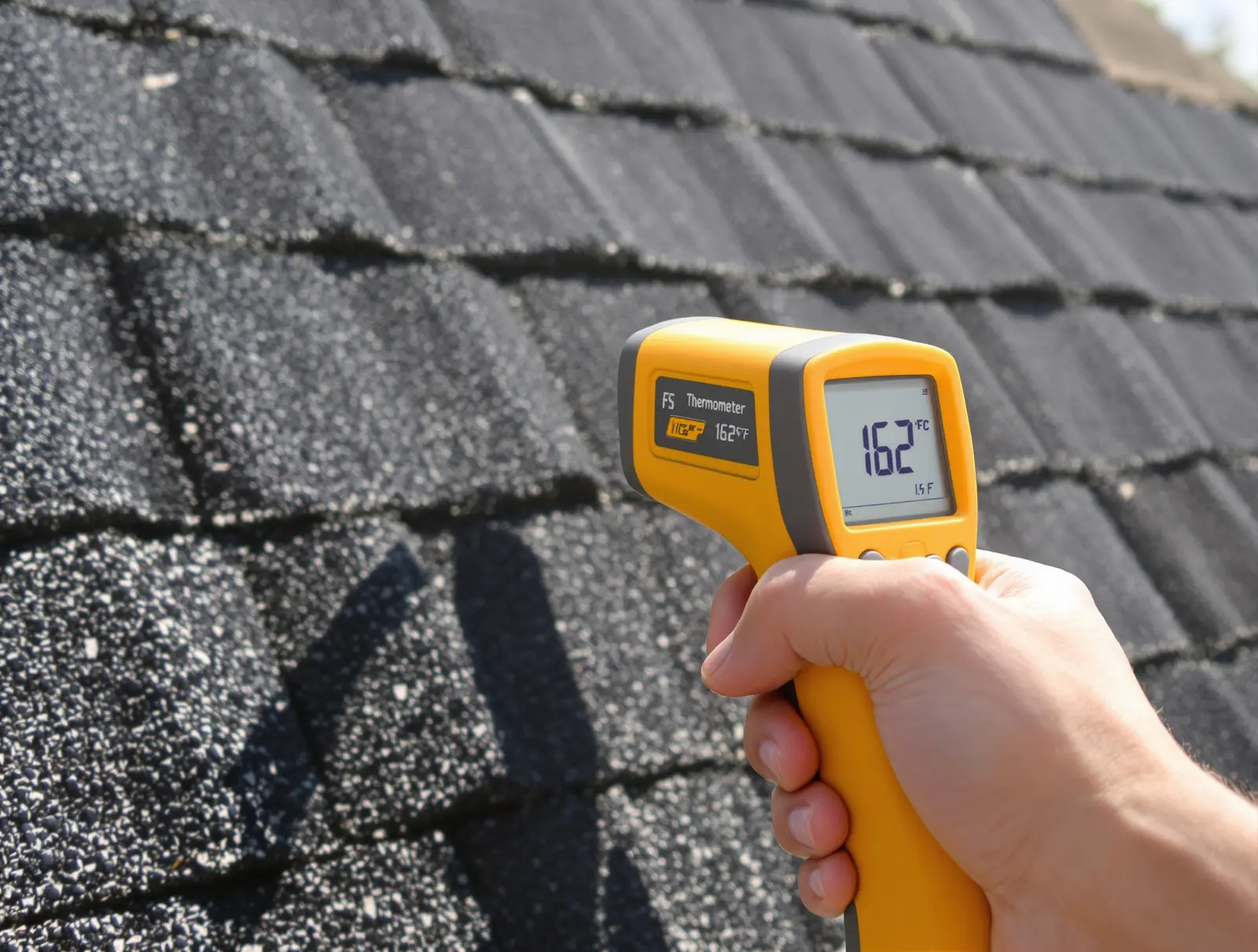
What You Need
The only essential tool is an infrared thermometer. A infrared thermometer (also called a laser thermometer or temperature gun) lets you read the surface temperature of any object by pointing at it from several feet away. You do not need to touch the roof, climb a ladder, or enter the attic for most of these measurements.
Additional helpful items include a notebook or phone for recording temperatures, a flashlight if you plan to look into the attic, and a tape measure for checking insulation depth. None of these are expensive or specialized. You likely already have most of them.
Timing matters. Take your measurements on a clear, sunny day between 1:00 PM and 3:00 PM, when solar radiation is at or near its daily peak. Overcast days, mornings, and late afternoons will produce lower readings that understate your roof's heat contribution. You want to measure worst-case conditions because that is when your comfort problem is worst.
Safety note: you do not need to get on the roof. An infrared thermometer reads surface temperature from a distance. Stand on the ground and aim at the roof surface from your yard or driveway. The readings are accurate from 15-30 feet away as long as you keep the laser dot on the roof surface and not on a nearby tree or gutter.
Steps 1-3: Outdoor Baseline Measurements
Step 1: Measure your roof surface temperature
Stand in your yard where you have a clear line of sight to the roof. Point the infrared thermometer at the center of a large roof plane (not near edges, ridges, or valleys where shadows or airflow differ). Pull the trigger and hold steady for 2-3 seconds until the reading stabilizes. Record the number.
Take three readings on different parts of the roof. Measure the south-facing slope (hottest), the west-facing slope (second hottest in the afternoon), and the north-facing slope (coolest). If your roof has only two slopes, measure both. Record all readings and note which direction each measurement faces. The south-facing reading is your peak roof surface temperature.
Step 2: Measure a reference surface
Point the thermometer at your concrete driveway or sidewalk in direct sun. This gives you a comparison point. Concrete in full sun on a 95°F day typically reads 125-140°F. Your dark shingle roof should read 15-35°F hotter than the sunlit concrete. If it does not, double-check that you are reading the roof surface and not the gutter or fascia.
Step 3: Measure ambient air temperature
Point the thermometer at a shaded surface on the north side of your house — a wall or the ground in full shade. This approximates the outdoor air temperature. Record this number as your baseline. Every other measurement is relative to this baseline. On a Gulf Coast summer afternoon, this will typically read 90-100°F.
Checkpoint
At this point, you should have three numbers: your peak roof surface temperature (typically 145-170°F for dark shingles), your reference concrete temperature (typically 125-140°F), and your ambient air temperature (typically 90-100°F). If your roof surface reads within 10°F of the concrete, your thermometer may be reading the wrong surface — try again from a different angle.
Steps 4-5: Attic Measurements
Step 4: Measure attic air temperature
Open your attic access hatch or pull-down stairs. You do not need to climb into the attic for this measurement. Hold the thermometer at the opening and aim it at the air space inside the attic, pointing toward the center of the attic (not directly at the roof deck or insulation). Wait 30 seconds for the reading to stabilize — the initial reading may be affected by the cooler air from the room below. Record the number.
If your attic hatch is in a hallway closet, be aware that opening it introduces conditioned air into the attic. Take your reading quickly (within the first 30-60 seconds) before the mixing significantly changes the attic air temperature. The most accurate reading comes from a quick open-measure-close sequence.
Step 5: Measure the underside of the roof deck
From the attic hatch opening, aim the thermometer at the underside of the roof deck — the plywood or OSB visible between the rafters. This temperature tells you how much heat has conducted through your roof. On a dark shingle roof, the deck underside typically reads 140-160°F. On a light metal roof, it reads 100-120°F. The difference between your roof deck reading and your attic air reading tells you how effective your ventilation is at removing heat.
Checkpoint
You now have five measurements. Your attic air temperature should be 30-60°F above outdoor ambient. If your attic air is within 20°F of ambient, you have effective ventilation. If your attic air is within 10°F of the deck temperature, your ventilation is poor — hot air is not being removed. If the deck underside reads within 10°F of the exterior roof surface, the roof material is conducting heat efficiently (typical for thin materials like shingles).
Think about it...
You measure a south-facing dark shingle roof at 162°F, attic air at 148°F, and the roof deck underside at 155°F. The outdoor ambient temperature is 96°F. What does the 7°F gap between deck underside (155°F) and attic air (148°F) tell you?
Steps 6-7: Interior Measurements
Step 6: Measure ceiling surface temperature
Close the attic hatch and go to the hottest upstairs room. Point the thermometer at the ceiling in the center of the room. Record the temperature. Then measure the ceiling near an exterior wall and near the attic hatch. Record all three readings. The ceiling surface temperature is the final barrier between your attic and your living space.
A well-insulated ceiling should read within 2-4°F of room air temperature. If your room is set to 74°F and the ceiling reads 76-78°F, your insulation is doing its job reasonably well. If the ceiling reads 82°F or higher, insulation is thin, damaged, or missing in that area. Ceiling temperatures above 85°F indicate seriously inadequate insulation — likely R-11 or less.
Step 7: Measure supply register temperature
With the air conditioning running (set it 5°F below current room temperature to ensure it runs continuously), hold the thermometer 2 inches from a supply register in the hottest room. Record the temperature. Then go to a supply register as close to the HVAC unit as possible (often a hallway or the room nearest the unit) and measure that register too. Record both numbers.
The difference between these two readings reveals your duct loss. The register near the unit should blow air at 55-62°F. The far register should be within 5-8°F of that in a well-insulated, well-sealed duct system. If the far register reads 10-15°F warmer than the near register, your ducts are losing significant capacity. If the difference is greater than 15°F, your ductwork is a primary contributor to your comfort problem.
Checkpoint
You now have all the measurements you need. Seven or eight temperature readings, taken in 20-30 minutes, with a $20 tool. These numbers tell a complete story about how heat moves from your roof to your living space. The next section shows you what they mean.
What Your Numbers Mean
Calculate three key temperature drops from your data. Each one isolates a specific part of the heat chain and tells you how well that component is performing.
Ventilation effectiveness: Roof deck minus attic air
If the gap is 20°F or more, your ventilation is working. The attic air is significantly cooler than the deck, meaning outdoor air is being pulled through and carrying heat out. If the gap is less than 10°F, your attic air temperature is nearly the same as the deck temperature, which means hot air is trapped. Check for blocked soffit vents, sealed ridge vents, or insufficient vent area.
Insulation effectiveness: Attic air minus ceiling surface
This temperature drop should be large — 50°F or more in a well-insulated home. If your attic air is 140°F and your ceiling reads 78°F, that is a 62°F drop, indicating good insulation (likely R-30 or better). If your attic is 140°F and your ceiling reads 88°F, that 52°F drop is marginal. If the drop is less than 45°F, your insulation is definitely insufficient and should be your first improvement priority.
Duct performance: Near register minus far register
A difference of 5°F or less means your ducts are in good shape. A difference of 5-10°F suggests moderate losses worth monitoring. A difference of 10-15°F indicates duct insulation is inadequate or there are minor leaks. A difference greater than 15°F signals significant duct problems — disconnected joints, torn insulation, or major leaks — that should be fixed before any roof-level improvements.
Common misconception:
If my roof surface is hot, replacing the roof is the best way to fix my comfort problem.
Gulf Coast reality:
Every roof gets hot — that is normal physics. What matters is how well the rest of your system handles that heat. If your insulation and ductwork are performing well (large temperature drops at each stage), a cooler roof helps but is not urgent. If your ducts are losing 15°F and your ceiling insulation provides less than a 45°F drop, those are cheaper and more impactful fixes than a new roof.
Common Measurement Mistakes
Aiming at the wrong surface is the most common error. Infrared thermometers read whatever the laser dot is on. If the dot slips to the gutter, fascia, or a shadow line, you will get a misleading reading. Make sure the dot is squarely on the roof material, not on flashing, trim, or a nearby tree branch. Take multiple readings and discard any that seem inconsistent.
Measuring at the wrong time of day produces misleadingly low numbers. If you measure at 10 AM, your roof surface may read 130°F instead of the 165°F it reaches at 2 PM. Morning measurements understate the problem. Always measure between 1:00 PM and 3:00 PM on a clear day for worst-case readings. If it is overcast, wait for a sunny day.
Measuring through glass does not work. If you try to read your roof temperature through a window, the glass blocks infrared radiation and you will read the glass temperature instead. Always measure from outside, standing in the yard or on the driveway with a clear line of sight to the roof surface.
Not accounting for emissivity can cause small errors on metal surfaces. Most infrared thermometers are factory-set for an emissivity of 0.95, which is correct for asphalt, concrete, and painted surfaces. Bare (unpainted) metal has much lower emissivity and will read incorrectly low. If you have bare metal roofing, set your thermometer's emissivity to 0.30-0.50 or place a piece of electrical tape on the surface and measure the tape after it reaches thermal equilibrium (about 2 minutes).
Think about it...
A homeowner's measurements show: roof surface 158°F, attic air 152°F, ceiling surface 86°F, near register 58°F, far register 74°F. Which measurement indicates the most urgent problem?
Recording and Using Your Data
Write down your measurements with the date, time, and outdoor conditions. Note the outdoor temperature, cloud cover, and wind conditions. This context helps you compare measurements over time. If you take readings before and after an improvement (such as adding insulation or sealing ducts), consistent conditions make the comparison meaningful.
Your measurements are the foundation for informed decisions about improvements. If your duct loss is 16°F, you know duct sealing should come first. If your ceiling is 88°F, insulation is the priority. If both are in good shape but your roof surface reads 165°F, a cooler roof material is the remaining lever. The numbers tell you the right sequence — and they prevent contractors from selling you the wrong fix.
Consider sharing your measurements with any contractor you consult. A contractor who sees that you have already measured and understand the system is less likely to oversell and more likely to provide targeted recommendations. Your data gives you leverage and credibility in any conversation about home comfort improvements.
Use our heat gain estimator tool to model the effect of improvements. Enter your measured roof temperature, insulation level, and duct condition to see how changes to each component would affect your overall heat gain. Compare the estimated impact of a cooler roof versus better insulation versus duct sealing to prioritize your investment.
What to do next
Quick recap
With a $15-25 infrared thermometer and 30 minutes, you can measure your roof surface temperature, attic temperature, ceiling temperature, and duct performance. These measurements identify which part of the heat chain is the weakest link in your home.
Your next step
Take measurements on the next clear afternoon and calculate your three key temperature drops — ventilation effectiveness, insulation effectiveness, and duct performance.
Keep reading