If your Gulf Coast home is uncomfortably hot, the cause is almost always one of five things: ductwork leaking in a superheated attic, inadequate ceiling insulation, blocked soffit vents, a dark heat-absorbing roof, or air leaks between your attic and living space. This guide ranks every common cause by probability, walks you through how to check each one, and tells you honestly whether the fix involves your roof or something else entirely.
After reading this guide, you will know how to systematically diagnose why your home is hot — and which professional to call based on what you find.

What This Section Covers
This pillar is the starting point for every homeowner whose Gulf Coast home is too hot. Whether your upstairs is sweltering, your AC runs nonstop, your electric bill is climbing, or one room refuses to cool down, the diagnostic process starts here. Every comfort problem has a cause, and that cause determines the solution.
The pages in this section work together as a diagnostic system. The overview you are reading now ranks the most common causes and introduces the diagnostic framework. The sub-pages dive deep into specific symptoms. And the Cause Finder tool walks you through a guided diagnosis with personalized results.
This is not a roofing sales pitch. Many of the most common causes of a hot Gulf Coast home have nothing to do with the roof. Ductwork problems, insulation gaps, and HVAC issues each require different professionals and different solutions. This guide identifies what is actually wrong — and tells you the truth about what will fix it.
Start Here: The Cause Finder Tool
The fastest way to diagnose your hot home is the Hot Upstairs Cause Finder. Answer 10 questions about your home, your symptoms, and what you have already noticed. The tool returns a ranked list of probable causes with specific next steps for each one. It takes about 2 minutes.
The Cause Finder uses the same diagnostic logic laid out in this guide, but personalized to your situation. It weights your answers against Gulf Coast climate data and building science research to rank the most likely contributors. If you prefer to read through the causes yourself first, keep going — this page covers everything the tool considers.
Explore by Symptom
Upstairs Is Hotter Than Downstairs
The most common complaint. Five ranked causes specific to Gulf Coast two-story homes, with DIY checks for each.
Read the diagnostic guide →AC Runs All Day, House Won't Cool
Your system runs constantly but the house stays warm. Four causes and how to diagnose each one without calling anyone yet.
Read the diagnostic guide →Electric Bill Too High in Summer
Gulf Coast summer bills can be shocking. Learn what is normal, what is excessive, and where the money is actually going.
Benchmark your bill →Cause Finder Tool
Answer 10 questions. Get a personalized ranked diagnosis with specific next steps. Takes 2 minutes.
Take the diagnostic →One Room Is Always Hot
When a single room stays warmer than the rest, the cause is usually isolated and identifiable with a few checks.
Diagnose the problem →House Feels Humid with AC On
Humidity makes 74°F feel like 80°F. Why your AC might be running without removing enough moisture.
Understand humidity →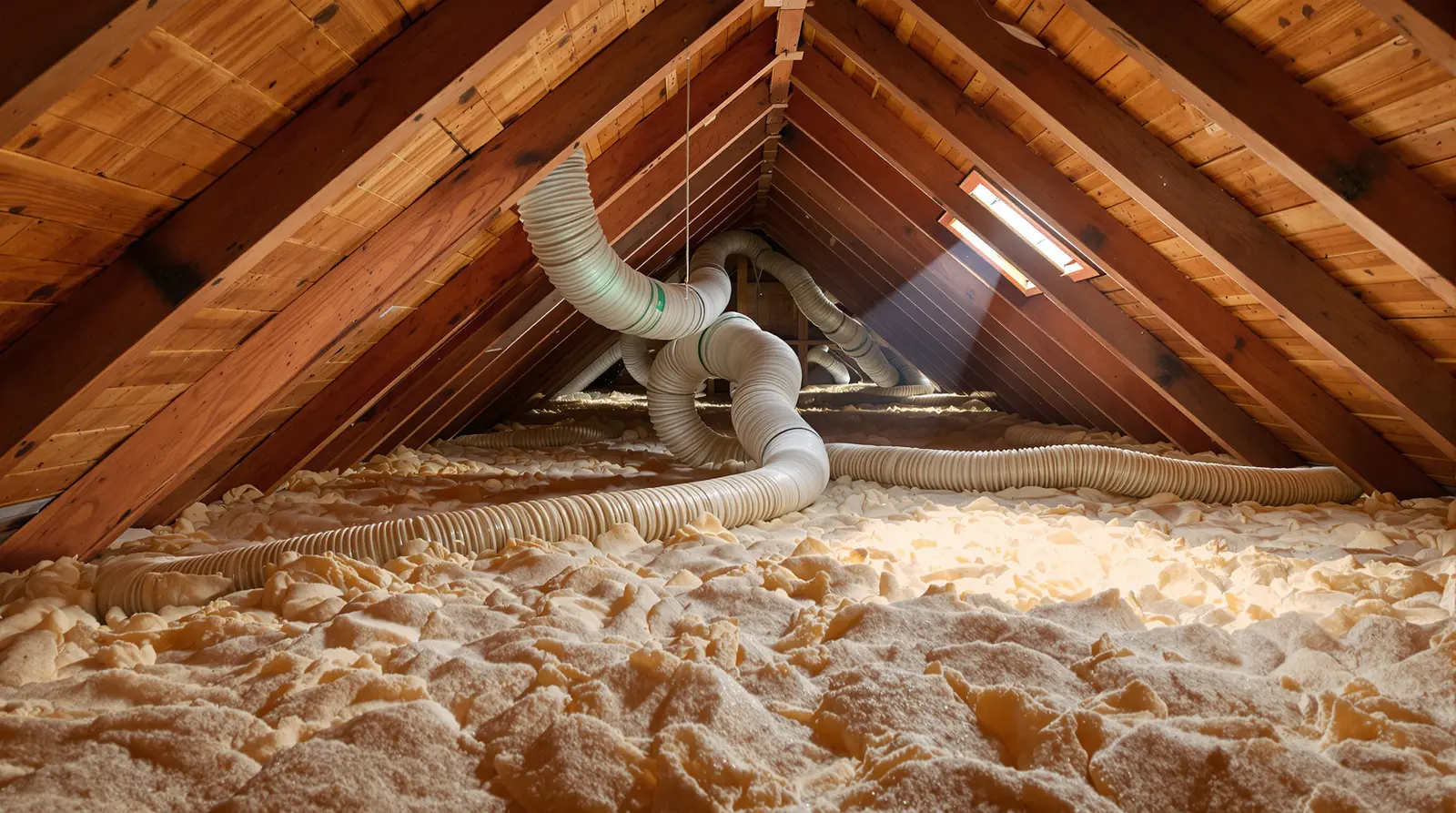
The Most Common Causes, Ranked for the Gulf Coast
The most common causes of a hot home in Gulf Coast climates are, in order of probability: (1) ductwork running through a superheated attic, (2) inadequate attic insulation, (3) blocked or insufficient soffit ventilation, (4) a dark, heat-absorbing roof, and (5) air leaks between the attic and the living space. Each of these problems has a different solution, and many of them have nothing to do with the roof.
#1: Ductwork Running Through a Hot Attic
This is the single biggest hidden energy drain in Gulf Coast homes. Your air conditioning system cools air to about 55°F at the air handler. That cooled air then travels through ductwork that may be sitting in a 140-160°F attic. If the ducts have gaps, disconnected joints, or deteriorated insulation, the air arriving at your supply registers can be 15-25°F warmer than it should be.
The math is brutal. A duct system with 20% leakage in a 150°F attic loses roughly 30-40% of its cooling capacity before the air ever reaches your rooms. Your AC is working perfectly — it is just delivering conditioned air to the attic instead of your living space, which is why your summer electric bill keeps climbing. This is a Tier 3 problem: it requires an HVAC contractor or duct specialist, not a roofer.
How to check it yourself: Go into your attic with a flashlight. Look at the ductwork. Are there visible gaps at the joints? Is the flex duct insulation torn or compressed? Place your hand near connection points — can you feel cool air escaping? Then go inside and hold a thermometer at each supply register. If the air temperature varies by more than 3°F between registers, or if the supply air is warmer than 60°F, you likely have duct problems.
Duct leakage is measured as a percentage of total system airflow. Building codes (IECC 2021) require duct leakage below 4% for new construction, but older Gulf Coast homes commonly test at 15-30%. The temperature of the air surrounding the duct (the attic temperature) determines how much heat the duct absorbs per linear foot. At 150°F attic temperatures with R-6 flex duct insulation, supply air can gain 1-2°F per 10 linear feet of duct run. A typical home has 80-120 linear feet of duct in the attic, meaning the supply air can warm by 8-24°F before reaching the register.
Professional duct leakage testing uses a duct blaster to pressurize the system and measure total leakage. This test typically costs $150-300 and provides a precise leakage percentage. It is the single most informative test you can request from an HVAC contractor.
#2: Inadequate Attic Insulation
The ceiling between your attic and your living space is the thermal boundary between 150°F and 74°F. If the insulation in that boundary is thin, compressed, missing in spots, or has settled over time, heat pours through the ceiling into your rooms. The Department of Energy recommends R-38 to R-60 for attic insulation in Gulf Coast climate zones (Zone 2), but many older homes have R-11 to R-19.
Insulation degrades over time. Fiberglass batts compress, blown cellulose settles by 10-20% in the first few years, and both types perform poorly if they get wet from condensation or roof leaks. A home that was insulated to code in 1995 may have half the effective insulation value today.
How to check it yourself: Go into your attic and measure the depth of insulation on the attic floor. For fiberglass batts, look at the label — it will state the R-value. For blown insulation, measure the depth in inches: blown fiberglass needs about 13-14 inches for R-38, while blown cellulose needs about 10-11 inches. Check for gaps, especially around light fixtures, plumbing penetrations, and the attic hatch. Any gap is a thermal short circuit.
#3: Blocked or Insufficient Soffit Ventilation
Soffit vents are the intake side of your attic ventilation system. They let cooler outside air enter at the eaves, flow up under the roof deck, and exit through ridge vents or other exhaust vents at the top. When soffit vents are blocked — by insulation pushed against the eave, by paint, by debris, or by construction that never included them — the entire ventilation circuit fails.
Without intake air, exhaust vents cannot function. A ridge vent with no soffit intake does almost nothing. The attic becomes a sealed oven, and peak temperatures can reach 160-180°F instead of the 130-140°F you would see with proper ventilation. That 20-40°F difference in attic temperature directly affects heat transfer through your ceiling and is a major contributor when the upstairs stays hotter than the downstairs.
How to check it yourself: Go into your attic with a flashlight. Move to the eave area where the roof meets the exterior wall. Look for light coming through the soffit vents from outside. If you see insulation pushed up against the soffit area with no air gap, the vents are blocked. From outside, look up at the soffit — can you see vent openings? Hold a tissue near them on a breezy day. If the tissue does not move, air is not flowing.
Think about it...
If your attic has a ridge vent but the soffit vents are blocked with insulation, what happens to ventilation?
#4: Dark, Heat-Absorbing Roof
A dark asphalt shingle roof reaches 155-170°F on a 95°F Gulf Coast summer day. A light-colored or cool-rated roof reaches 105-130°F under the same conditions. That 30-60°F difference in surface temperature translates to a 15-30°F difference in peak attic temperature, which directly affects how much heat crosses your ceiling into the living space.
Roof color and material matter, but they are rarely the primary cause of an uncomfortable home. A dark roof contributes to higher attic temperatures, but if your ductwork is sealed and your insulation is adequate, the ceiling thermal barrier handles the extra heat load. A dark roof becomes the dominant problem when it compounds other issues — thin insulation plus a dark roof is significantly worse than either problem alone.
This is a Tier 1 problem when the roof is a significant contributor. If you are already planning a roof replacement, choosing a cool-colored or cool-rated material is a straightforward way to reduce heat gain. If you are not planning a reroof, improving insulation and sealing ducts typically delivers more cooling benefit per dollar spent.
#5: Air Leaks Between Attic and Living Space
Air sealing is the invisible partner of insulation. Every penetration through the ceiling — recessed lights, plumbing pipes, electrical wires, the attic hatch, bathroom exhaust fans, and HVAC registers — is a potential pathway for hot attic air to leak into your home. Insulation slows heat transfer by conduction, but it does nothing to stop heated air from physically flowing through gaps.
In older Gulf Coast homes, the cumulative effect of ceiling penetrations can be equivalent to leaving a window open. A blower door test typically reveals 10-30% more air leakage than homeowners expect, with a significant portion coming from attic-to-living-space pathways. Sealing these penetrations with caulk, spray foam, and weatherstripping before adding insulation is critical — insulation over an air leak is like wearing a sweater with holes.
How to check it yourself: On a hot day, hold your hand near recessed light fixtures in the ceiling below the attic. Do they feel warm? Check the attic hatch — is there weatherstripping around the edges, or can you see daylight around the frame? In the attic, look at plumbing and electrical penetrations through the ceiling. Are the gaps sealed, or can you see into the room below?
Common misconception:
Adding more insulation is always the best first step to cool your home.
Gulf Coast reality:
Insulation without air sealing is like wearing a sweater with holes — it helps, but hot air still flows through every gap. In Gulf Coast homes, sealing the air leaks BEFORE adding insulation typically delivers 2-3x more cooling benefit per dollar. And if your ductwork is leaking in the attic, neither insulation nor air sealing will fix the problem until the ducts are sealed first.
Why the Gulf Coast Is Different
Standard building science advice often comes from cold-climate research. Recommendations like "seal everything as tight as possible" and "more ventilation is always better" do not always apply in hot-humid climates like the Gulf Coast. The physics of heat and moisture work differently when 90°F dew points and 80%+ relative humidity are normal for 5 months of the year.
Gulf Coast attics face a unique thermal challenge. The combination of intense solar radiation (5.5-6.5 kWh/m² per day in summer), high ambient temperatures (95°F+ for 90-120 days per year), and extreme humidity creates conditions that do not exist in northern climates. A dark shingle roof in Biloxi absorbs significantly more total heat energy over the year than the same roof in Chicago, simply because the cooling season is 3-4 times longer.
Moisture management complicates ventilation decisions. In cold climates, attic ventilation is primarily about removing moisture in winter. In the Gulf Coast, ventilation serves both temperature reduction in summer and moisture control year-round. But too much ventilation in a humid climate can actually introduce moisture-laden outdoor air into the attic, causing condensation on cool surfaces like HVAC equipment and ductwork. This is a balance that standard "more vents = better" advice ignores.
Cooling loads dominate energy costs. In a typical Gulf Coast home, 40-60% of the annual electric bill goes to cooling. This means improvements that reduce cooling load — duct sealing, insulation, cool roofing — have a much larger financial impact than the same improvements in a climate where heating is the primary energy consumer.
Think about it...
Why might adding more attic ventilation actually cause problems in a Gulf Coast home?
How to Use This Diagnostic Guide
Start with your symptom, not with a product. If your upstairs is hot, read Why the Upstairs Is Hotter Than the Downstairs. If your AC runs all day, read Your AC Runs All Day but the House Won't Cool Down. If your bills are high, read Why Your Gulf Coast Electric Bill Is So High in Summer. Each page walks through a ranked diagnostic sequence specific to that symptom.
Check the easy things first. Before spending any money, do the free DIY checks described on each page. You can identify blocked soffit vents, disconnected ductwork, missing insulation, and air leaks with nothing more than a flashlight, a infrared thermometer, and 30 minutes in the attic.
Understand the three-tier diagnosis model. Every cause identified on this site falls into one of three categories. Tier 1 means the roof system is a significant contributor, and a roofing professional can help. Tier 2 means the improvement is best addressed during a roof replacement. Tier 3 means the cause is not roof-related — it requires an HVAC contractor, insulation specialist, or energy auditor, and no roofing CTA will appear on that page. We are not trying to sell you a roof when the problem is your ductwork.
Which Professional to Call (Based on What You Find)
Ductwork problems → HVAC contractor. Ask specifically about duct leakage testing (a duct blaster test) and duct sealing. Not all HVAC companies offer this service. Look for contractors who are BPI (Building Performance Institute) certified or who specifically advertise duct testing and sealing.
Insulation and air sealing → insulation contractor or energy auditor. An energy auditor with a blower door can quantify your air leakage and identify the biggest gaps. Some insulation contractors also offer air sealing, but not all. Ask whether they seal penetrations before adding insulation.
Roof-related heat gain → roofing contractor who understands building performance. Not every roofer thinks about thermal performance. When the diagnosis points to roof color, material, ventilation design, or radiant barriers, you need a contractor who understands how the roof system interacts with the attic assembly — not just someone who installs shingles.
Humidity and moisture problems → start with an energy auditor. Humidity issues often involve multiple interacting systems — HVAC sizing, ventilation rates, air sealing, and ductwork. An energy auditor can assess the whole picture rather than just one component.
Common misconception:
The HVAC company, the roofer, and the insulation company will all give you an objective diagnosis.
Gulf Coast reality:
Each contractor is incentivized to diagnose the problem as the thing they sell. The HVAC company diagnoses an HVAC problem. The roofer diagnoses a roof problem. The insulation company diagnoses an insulation problem. An independent energy audit from a BPI-certified auditor ($200-500) gives you a diagnosis that is not tied to selling a particular product or service.
What Common Fixes Cost (Gulf Coast Pricing)
Duct sealing and insulation: This addresses the most common cause of a hot home and typically pays for itself in 1-3 years through reduced energy bills. Many utility companies offer rebates that reduce the cost further.
Attic insulation upgrade to R-38: This addresses the second most common cause. The wide price range depends on the existing insulation depth and whether the installer includes air sealing as part of the job. Always ask whether air sealing is included.
Cool roof replacement: This is a significant investment that addresses the fourth most common cause. A cool roof makes sense when you are already due for a replacement, but it is rarely the most cost-effective first step for a hot home.
Energy audit with blower door and duct testing: This is the best $200-500 you can spend before any improvement. It tells you exactly where the biggest energy losses are and helps you prioritize your spending. Some utility companies subsidize or reimburse audit costs.
Think about it...
If you had $2,000 to spend on reducing heat in your Gulf Coast home, and you had not yet checked your ductwork or insulation, what would be the most effective first step?
Gulf Coast Climate: The Cooling Season Calendar
The Gulf Coast cooling season runs roughly from April through October — 7 months of the year. Peak attic stress occurs in June through September, when outdoor temperatures regularly exceed 90°F and solar radiation reaches its annual maximum. During these months, a dark shingle roof can reach 155-170°F by mid-afternoon, and attic air temperatures can stay above 120°F for 8-10 hours per day.
Monthly temperature benchmarks for South Mississippi, South Alabama, and the Florida Panhandle:
| Month | Avg High (°F) | Typical Peak Attic (°F) | Cooling Load |
|---|---|---|---|
| January | 58-62 | 70-85 | Minimal |
| February | 61-65 | 75-90 | Minimal |
| March | 68-72 | 85-105 | Light |
| April | 75-79 | 100-120 | Moderate |
| May | 83-87 | 115-140 | High |
| June | 89-93 | 135-160 | Peak |
| July | 91-95 | 140-165 | Peak |
| August | 91-95 | 140-165 | Peak |
| September | 87-91 | 130-155 | Peak |
| October | 79-83 | 110-130 | Moderate |
| November | 68-72 | 85-105 | Light |
| December | 60-64 | 72-90 | Minimal |
The danger zone is June through September. During these four months, attic temperatures consistently exceed 130°F during daylight hours. This is when duct losses are most severe, when insulation gaps matter most, and when the difference between a dark roof and a cool roof has its greatest impact on energy bills and comfort.
Gulf Coast Attic Stress Calendar
Average high temperature, humidity, and attic stress index (1-10) by month. June-September danger zone highlighted.
The Diagnostic Sequence: Check These in Order
The most efficient diagnostic approach starts with the cheapest, most common problems first. This is not a random list — it is ordered by probability and ease of checking. Work through it in order, and you will identify the likely cause with the least effort. Or, if you prefer a guided approach, the interactive cause finder tool walks you through this logic in 2 minutes.
- Step 1: Measure supply register temperatures. Hold a thermometer at each supply register while the AC is running. Supply air should be 55-62°F. If it is warmer than 65°F, or if different registers show temperatures more than 3°F apart, you likely have duct problems. This takes 10 minutes and requires only a thermometer.
- Step 2: Check your attic insulation depth. Open the attic hatch and measure the insulation depth. For blown insulation, you need at least 10 inches of cellulose or 14 inches of fiberglass to meet R-38. For batts, check the label. This takes 5 minutes with a tape measure.
- Step 3: Check your soffit vents. From inside the attic, look toward the eaves. Can you see daylight through the soffit vents? Is insulation blocking the vent openings? From outside, look up at the soffits — are there vent openings, and can you feel air movement? This takes 10 minutes with a flashlight.
- Step 4: Note your roof color and material. Step outside and look at your roof. Dark brown, charcoal, or black shingles absorb significantly more heat than light gray, tan, or white materials. If you have a dark roof AND thin insulation, both problems compound each other.
- Step 5: Check for air leaks at ceiling penetrations. On a hot day, hold your hand near recessed lights, the attic hatch frame, bathroom exhaust fans, and plumbing penetrations through the ceiling. Warm air flowing down from the attic indicates unsealed gaps.
If you complete all five checks, you will have a working diagnosis for your home. The most common finding is that multiple causes contribute — duct leaks combined with thin insulation, or a dark roof combined with blocked soffits. The fix should address the biggest contributor first.
Frequently Asked Questions
Why is my house so hot even with the AC running?
The most common reason is that heat is entering your home faster than your AC can remove it. In Gulf Coast homes, this usually means ductwork running through a 140-160°F attic is losing cooled air before it reaches your rooms, insulation is thin or compressed, or your dark roof is absorbing massive solar heat. Your AC may be working fine — it is just fighting a losing battle against heat gain.
Is the upstairs supposed to be hotter than the downstairs?
Some temperature difference is normal because hot air rises. But in a well-insulated, properly sealed Gulf Coast home, the difference should be 2-4°F, not 8-15°F. If you are seeing a gap larger than 4°F, something structural is allowing excess heat into your upper floor — usually ductwork losses, inadequate attic insulation, or blocked soffit vents.
Will a new roof make my house cooler?
It depends on why your house is hot. If your current roof is dark-colored and your attic reaches 150°F or higher, switching to a light-colored or cool-rated roof can reduce attic temperatures by 20-40°F. But if your primary problem is leaking ductwork or thin insulation, a new roof alone will not fix the comfort issue. The right diagnostic approach identifies whether the roof is the main contributor before you spend money on it.
How hot should my attic be in summer?
On a 95°F Gulf Coast summer day, a typical vented attic with dark shingles reaches 140-160°F. With a cool-colored roof and proper ventilation, that drops to 110-130°F. An unvented attic with spray foam on the roofline stays within 10-15°F of the living space. There is no single "correct" attic temperature — what matters is how much heat transfers through the ceiling into your rooms.
What is the most cost-effective way to reduce heat in my home?
For most Gulf Coast homes, the single most cost-effective improvement is sealing and insulating ductwork in the attic. Leaky ducts in a 150°F attic can waste 20-40% of your cooling capacity. After duct sealing, adding attic insulation to R-38 or higher typically delivers the next best return. Cool roofing and radiant barriers help, but usually rank third or fourth in cost-effectiveness unless your current roof is very dark and your insulation is already adequate.
Does attic ventilation cool my house?
Not directly. Attic ventilation reduces peak attic temperatures by 10-20°F, which slows heat transfer through your ceiling. But ventilation alone cannot cool your living space — it only reduces the temperature difference driving heat into your home. In Gulf Coast hot-humid climates, ventilation also plays a critical moisture management role, preventing condensation and mold growth on the underside of the roof deck.
Why is my electric bill so high compared to my neighbors?
If your home is similar in size but your bill is significantly higher, the usual suspects are: ductwork losses in the attic (the number one hidden energy drain), inadequate insulation (anything below R-30 in the Gulf Coast is underperforming), a dark roof absorbing more heat than a lighter-colored roof, or an HVAC system that is undersized for the actual heat load. Comparing your per-square-foot cost to Gulf Coast averages of $0.10-0.20 per square foot per month in summer helps you benchmark whether your usage is abnormal.
Should I get an energy audit or just replace equipment?
Get a diagnostic assessment before replacing anything. An energy audit with blower door testing and duct leakage testing typically costs $200-500 and identifies exactly where your home is losing energy. Replacing your AC when the real problem is duct leaks wastes $5,000-12,000 on equipment that will fight the same losing battle. Fix the building envelope first, then size equipment to match the reduced load.
What to do next
Quick recap
The most common causes of a hot Gulf Coast home are ductwork losses, inadequate insulation, blocked soffit vents, dark roofing, and air leaks — in that order. Many of these are not roof problems.
Your next step
Take the 2-minute Cause Finder diagnostic to identify the most likely cause for your specific home, or start with the five-step DIY check sequence above.
Keep reading